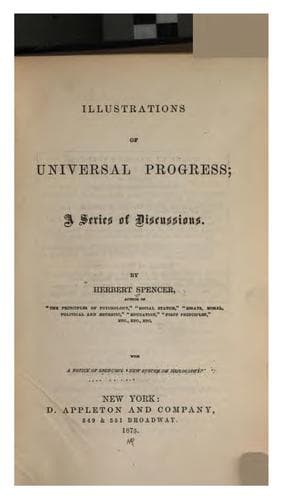
Illustrations of Universal Progress: A Series of DiscussionsSpencer, Herbert
Philosophy
Illustrations of Universal Progress: A Series of Discussions
Spencer, Herbert
Philosophy; Political science; Science
When mechanics had reached the point to which Galileo brought it--when the
simple laws of force had been disentangled from the friction and
atmospheric resistance by which all their earthly manifestations are
disguised--when progressing knowledge of _physics_ had given a due insight
into these disturbing causes--when, by an effort of abstraction, it was
perceived that all motion would be uniform and rectilinear unless
interfered with by external forces--and when the various consequences of
this perception had been worked out; then it became possible, by the union
of geometry and mechanics, to initiate physical astronomy. Geometry and
mechanics having diverged from a common root in men's sensible experiences;
having, with occasional inosculations, been separately developed, the one
partly in connexion with astronomy, the other solely by analyzing
terrestrial movements; now join in the investigations of Newton to create a
true theory of the celestial motions. And here, also, we have to notice the
important fact that, in the very process of being brought jointly to bear
upon astronomical problems, they are themselves raised to a higher phase of
development. For it was in dealing with the questions raised by celestial
dynamics that the then incipient infinitesimal calculus was unfolded by
Newton and his continental successors; and it was from inquiries into the
mechanics of the solar system that the general theorems of mechanics
contained in the "Principia,"--many of them of purely terrestrial
application--took their rise. Thus, as in the case of Hipparchus, the
presentation of a new order of concrete facts to be analyzed, led to the
discovery of new abstract facts; and these abstract facts having been laid
hold of, gave means of access to endless groups of concrete facts before
incapable of quantitative treatment.
Public-domain text, read in full here on John Shaqi.
Reviews
Reviews
No reviews yet
Be the first to share your thoughts on this work.
Elsewhere in the archive
Join the Discussion
Join the discussion
Sign in to leave a comment or review.
Sign InorCreate an account