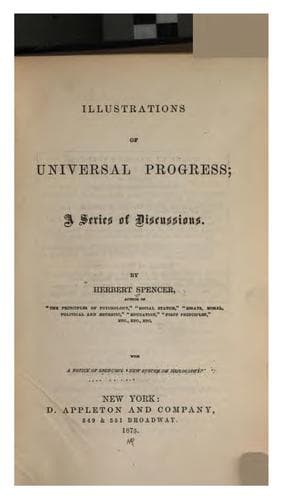
Illustrations of Universal Progress: A Series of DiscussionsSpencer, Herbert
Philosophy
Illustrations of Universal Progress: A Series of Discussions
Spencer, Herbert
Philosophy; Political science; Science
Not only do the sciences affect each other after this direct manner, but
they affect each other indirectly. Where there is no dependence, there is
yet analogy--_equality of relations_; and the discovery of the relations
subsisting among one set of phenomena, constantly suggests a search for the
same relations among another set. Thus the established fact that the force
of gravitation varies inversely as the square of the distance, being
recognized as a necessary characteristic of all influences proceeding from
a centre, raised the suspicion that heat and light follow the same law;
which proved to be the case--a suspicion and a confirmation which were
repeated in respect to the electric and magnetic forces. Thus again the
discovery of the polarization of light led to experiments which ended in
the discovery of the polarization of heat--a discovery that could never
have been made without the antecedent one. Thus, too, the known
refrangibility of light and heat lately produced the inquiry whether sound
also is not refrangible; which on trial it turns out to be.
In some cases, indeed, it is only by the aid of conceptions derived from
one class of phenomena that hypotheses respecting other classes can be
formed. The theory, at one time favoured, that evaporation is a solution of
water in air, was an assumption that the relation between water and air is
_like_ the relation between salt and water; and could never have been
conceived if the relation between salt and water had not been previously
known. Similarly the received theory of evaporation--that it is a diffusion
of the particles of the evaporating fluid in virtue of their atomic
repulsion--could not have been entertained without a foregoing experience
of magnetic and electric repulsions. So complete in recent days has become
this _consensus_ among the sciences, caused either by the natural
entanglement of their phenomena, or by analogies in the relations of their
phenomena, that scarcely any considerable discovery concerning one order of
facts now takes place, without very shortly leading to discoveries
concerning other orders.
To produce a tolerably complete conception of this process of scientific
evolution, it would be needful to go back to the beginning, and trace in
detail the growth of classifications and nomenclatures; and to show how, as
subsidiary to science, they have acted upon it, and it has reacted upon
them. We can only now remark that, on the one hand, classifications and
nomenclatures have aided science by continually subdividing the
subject-matter of research, and giving fixity and diffusion to the truths
disclosed; and that on the other hand, they have caught from it that
increasing quantitativeness, and that progress from considerations touching
single phenomena to considerations touching the relations among many
phenomena, which we have been describing.
Public-domain text, read in full here on John Shaqi.
Reviews
Reviews
No reviews yet
Be the first to share your thoughts on this work.
Elsewhere in the archive
Join the Discussion
Join the discussion
Sign in to leave a comment or review.
Sign InorCreate an account