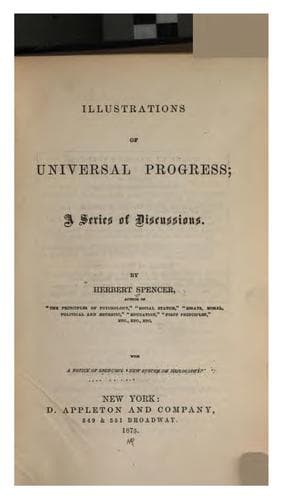
Illustrations of Universal Progress: A Series of DiscussionsSpencer, Herbert
Philosophy
Illustrations of Universal Progress: A Series of Discussions
Spencer, Herbert
Philosophy; Political science; Science
the past condition of our globe; the vast period it has taken to cool down
to its present state; and the immense age of the solar system--a purely
astronomical consideration.
Chemistry having advanced sufficiently to supply the needful materials, and
a physiological experiment having furnished the requisite hint, there came
the discovery of galvanic electricity. Galvanism reacting on chemistry
disclosed the metallic bases of the alkalies, and inaugurated the
electro-chemical theory; in the hands of Oersted and Ampere it led to the
laws of magnetic action; and by its aid Faraday has detected significant
facts relative to the constitution of light. Brewster's discoveries
respecting double refraction and dipolarization proved the essential truth
of the classification of crystalline forms according to the number of axes,
by showing that the molecular constitution depends upon the axes. In these
and in numerous other cases, the mutual influence of the sciences has been
quite independent of any supposed hierarchical order. Often, too, their
inter-actions are more complex than as thus instanced--involve more
sciences than two. One illustration of this must suffice. We quote it in
full from the _History of the Inductive Sciences_. In Book XI., chap. II.,
on "The Progress of the Electrical Theory," Dr. Whewell writes:--
"Thus at that period, mathematics was behind experiment, and a
problem was proposed, in which theoretical results were wanted for
comparison with observation, but could not be accurately obtained; as
was the case in astronomy also, till the time of the approximate
solution of the problem of three bodies, and the consequent formation
of the tables of the moon and planets, on the theory of universal
gravitation. After some time, electrical theory was relieved from
this reproach, mainly in consequence of the progress which astronomy
had occasioned in pure mathematics. About 1801 there appeared in the
_Bulletin des Sciences_, an exact solution of the problem of the
distribution of electric fluid on a spheroid, obtained by Biot, by
the application of the peculiar methods which Laplace had invented
for the problem of the figure of the planets. And, in 1811, M.
Poisson applied Laplace's artifices to the case of two spheres acting
upon one another in contact, a case to which many of Coulomb's
experiments were referrible; and the agreement of the results of
theory and observation, thus extricated from Coulomb's numbers
obtained above forty years previously, was very striking and
convincing."
Public-domain text, read in full here on John Shaqi.
Reviews
Reviews
No reviews yet
Be the first to share your thoughts on this work.
Elsewhere in the archive
Join the Discussion
Join the discussion
Sign in to leave a comment or review.
Sign InorCreate an account