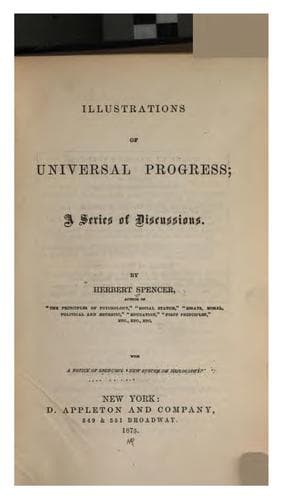
Illustrations of Universal Progress: A Series of Discussions — John Shaqi
Illustrations of Universal Progress: A Series of DiscussionsSpencer, Herbert
Philosophy
Illustrations of Universal Progress: A Series of Discussions
Spencer, Herbert
Philosophy; Political science; Science
PAGE
I. Progress: Its Law and Cause, 1
II. Manners and Fashion, 61
III. The Genesis of Science, 116
IV. The Physiology of Laughter, 194
V. The Origin and Function of Music, 210
VI. The Nebular Hypothesis, 239
VII. Bain on the Emotions and the Will, 300
VIII. Illogical Geology, 325
IX. The Development Hypothesis, 377
X. The Social Organism, 384
XI. Use and Beauty, 429
XII. The Sources of Architectural Types, 434
XIII. The Use of Anthropomorphism, 440
I. PROGRESS: ITS LAW AND CAUSE.
The current conception of Progress is somewhat shifting and indefinite.
Sometimes it comprehends little more than simple growth--as of a nation in
the number of its members and the extent of territory over which it has
spread. Sometimes it has reference to quantity of material products--as
when the advance of agriculture and manufactures is the topic. Sometimes
the superior quality of these products is contemplated: and sometimes the
new or improved appliances by which they are produced. When, again, we
speak of moral or intellectual progress, we refer to the state of the
individual or people exhibiting it; while, when the progress of Knowledge,
of Science, of Art, is commented upon, we have in view certain abstract
results of human thought and action. Not only, however, is the current
conception of Progress more or less vague, but it is in great measure
erroneous. It takes in not so much the reality of Progress as its
accompaniments--not so much the substance as the shadow. That progress in
intelligence seen during the growth of the child into the man, or the
savage into the philosopher, is commonly regarded as consisting in the
greater number of facts known and laws understood: whereas the actual
progress consists in those internal modifications of which this increased
knowledge is the expression. Social progress is supposed to consist in the
produce of a greater quantity and variety of the articles required for
satisfying men's wants; in the increasing security of person and property;
in widening freedom of action: whereas, rightly understood, social progress
consists in those changes of structure in the social organism which have
entailed these consequences. The current conception is a teleological one.
The phenomena are contemplated solely as bearing on human happiness. Only
those changes are held to constitute progress which directly or indirectly
tend to heighten human happiness. And they are thought to constitute
progress simply _because_ they tend to heighten human happiness. But
rightly to understand progress, we must inquire what is the nature of these
Public-domain text, read in full here on John Shaqi.
Reviews
Reviews
No reviews yet
Be the first to share your thoughts on this work.
Join the Discussion
Join the discussion
Sign in to leave a comment or review.
Sign InorCreate an account