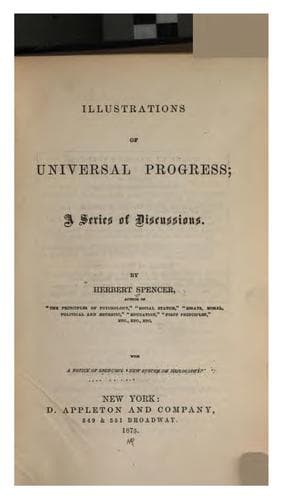
Illustrations of Universal Progress: A Series of DiscussionsSpencer, Herbert
Philosophy
Illustrations of Universal Progress: A Series of Discussions
Spencer, Herbert
Philosophy; Political science; Science
Quite in harmony with this position we find to be the admissions that the
sciences are as branches of one trunk, and that they were at first
cultivated simultaneously; and this harmony becomes the more marked on
finding, as we have done, not only that the sciences have a common root,
but that science in general has a common root with language,
classification, reasoning, art; that throughout civilization these have
advanced together, acting and reacting upon each other just as the separate
sciences have done; and that thus the development of intelligence in all
its divisions and subdivisions has conformed to this same law which we have
shown that the sciences conform to. From all which we may perceive that the
sciences can with no greater propriety be arranged in a succession, than
language, classification, reasoning, art, and science, can be arranged in a
succession; that, however needful a succession may be for the convenience
of books and catalogues, it must be recognized merely as a convention; and
that so far from its being the function of a philosophy of the sciences to
establish a hierarchy, it is its function to show that the linear
arrangements required for literary purposes, have none of them any basis
either in Nature or History.
There is one further remark we must not omit--a remark touching the
importance of the question that has been discussed. Unfortunately it
commonly happens that topics of this abstract nature are slighted as of no
practical moment; and, we doubt not, that many will think it of very little
consequence what theory respecting the genesis of science may be
entertained. But the value of truths is often great, in proportion as their
generality is wide. Remote as they seem from practical application, the
highest generalizations are not unfrequently the most potent in their
effects, in virtue of their influence on all those subordinate
generalizations which regulate practice. And it must be so here. Whenever
established, a correct theory of the historical development of the sciences
must have an immense effect upon education; and, through education, upon
civilization. Greatly as we differ from him in other respects, we agree
with M. Comte in the belief that, rightly conducted, the education of the
individual must have a certain correspondence with the evolution of the
race.
Public-domain text, read in full here on John Shaqi.
Reviews
Reviews
No reviews yet
Be the first to share your thoughts on this work.
Elsewhere in the archive
Join the Discussion
Join the discussion
Sign in to leave a comment or review.
Sign InorCreate an account