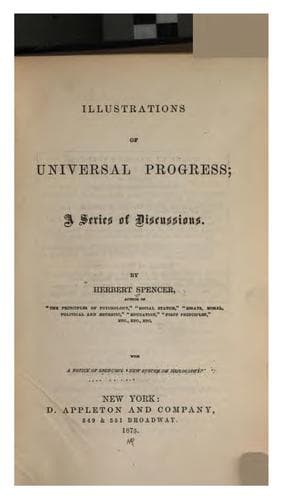
Illustrations of Universal Progress: A Series of DiscussionsSpencer, Herbert
Philosophy
Illustrations of Universal Progress: A Series of Discussions
Spencer, Herbert
Philosophy; Political science; Science
No one can contemplate the facts we have cited in illustration of the early
stages of science, without recognising the _necessity_ of the processes
through which those stages were reached--a necessity which, in respect to
the leading truths, may likewise be traced in all after stages. This
necessity, originating in the very nature of the phenomena to be analyzed
and the faculties to be employed, more or less fully applies to the mind of
the child as to that of the savage. We say more or less fully, because the
correspondence is not special but general only. Were the _environment_ the
same in both cases, the correspondence would be complete. But though the
surrounding material out of which science is to be organized, is, in many
cases, the same to the juvenile mind and the aboriginal mind, it is not so
throughout; as, for instance, in the case of chemistry, the phenomena of
which are accessible to the one, but were inaccessible to the other. Hence,
in proportion as the environment differs, the course of evolution must
differ. After admitting sundry exceptions, however, there remains a
substantial parallelism; and, if so, it becomes of great moment to
ascertain what really has been the process of scientific evolution. The
establishment of an erroneous theory must be disastrous in its educational
results; while the establishment of a true one must eventually be fertile
in school-reforms and consequent social benefits.
IV. THE PHYSIOLOGY OF LAUGHTER.
Why do we smile when a child puts on a man's hat? or what induces us to
laugh on reading that the corpulent Gibbon was unable to rise from his
knees after making a tender declaration? The usual reply to such questions
is, that laughter results from a perception of incongruity. Even were there
not on this reply the obvious criticism that laughter often occurs from
extreme pleasure or from mere vivacity, there would still remain the real
problem--How comes a sense of the incongruous to be followed by these
peculiar bodily actions? Some have alleged that laughter is due to the
pleasure of a relative self-elevation, which we feel on seeing the
humiliation of others. But this theory, whatever portion of truth it may
contain, is, in the first place, open to the fatal objection, that there
are various humiliations to others which produce in us anything but
laughter; and, in the second place, it does not apply to the many instances
in which no one's dignity is implicated: as when we laugh at a good pun.
Moreover, like the other, it is merely a generalization of certain
conditions to laughter; and not an explanation of the odd movements which
occur under these conditions. Why, when greatly delighted, or impressed
with certain unexpected contrasts of ideas, should there be a contraction
of particular facial muscles, and particular muscles of the chest and
abdomen? Such answer to this question as may be possible, can be rendered
only by physiology.
* * * * *
Public-domain text, read in full here on John Shaqi.
Reviews
Reviews
No reviews yet
Be the first to share your thoughts on this work.
Elsewhere in the archive
Join the Discussion
Join the discussion
Sign in to leave a comment or review.
Sign InorCreate an account