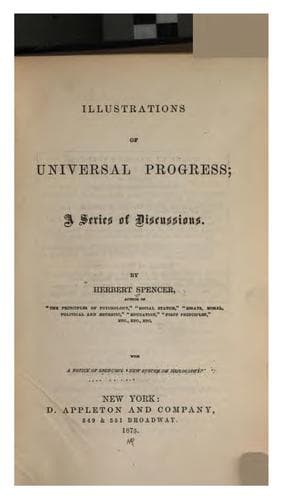
Illustrations of Universal Progress: A Series of DiscussionsSpencer, Herbert
Philosophy
Illustrations of Universal Progress: A Series of Discussions
Spencer, Herbert
Philosophy; Political science; Science
[G] For numerous illustrations see essay on "The Origin and Function
of Music."
This, however, is not the sole direction in which nervous excitement
expends itself. Viscera as well as muscles may receive the discharge. That
the heart and blood-vessels (which, indeed, being all contractile, may in a
restricted sense be classed with the muscular system) are quickly affected
by pleasures and pains, we have daily proved to us. Every sensation of any
acuteness accelerates the pulse; and how sensitive the heart is to
emotions, is testified by the familiar expressions which use heart and
feeling as convertible terms. Similarly with the digestive organs. Without
detailing the various ways in which these may be influenced by our mental
states, it suffices to mention the marked benefits derived by dyspeptics,
as well as other invalids, from cheerful society, welcome news, change of
scene, to show how pleasurable feeling stimulates the viscera in general
into greater activity.
There is still another direction in which any excited portion of the
nervous system may discharge itself; and a direction in which it usually
does discharge itself when the excitement is not strong. It may pass on the
stimulus to some other portion of the nervous system. This is what occurs
in quiet thinking and feeling. The successive states which constitute
consciousness, result from this. Sensations excite ideas and emotions;
these in their turns arouse other ideas and emotions; and so, continuously.
That is to say, the tension existing in particular nerves, or groups of
nerves, when they yield us certain sensations, ideas, or emotions,
generates an equivalent tension in some other nerves, or groups of nerves,
with which there is a connexion: the flow of energy passing on, the one
idea or feeling dies in producing the next.
Thus, then, while we are totally unable to comprehend how the excitement of
certain nerves should generate feeling--while, in the production of
consciousness by physical agents acting on physical structure, we come to
an absolute mystery never to be solved; it is yet quite possible for us to
know by observation what are the successive forms which this absolute
mystery may take. We see that there are three channels along which nerves
in a state of tension may discharge themselves; or rather, I should say,
three classes of channels. They may pass on the excitement to other nerves
that have no direct connexions with the bodily members, and may so cause
other feelings and ideas; or they may pass on the excitement to one or more
motor nerves, and so cause muscular contractions; or they may pass on the
excitement to nerves which supply the viscera, and may so stimulate one or
more of these.
Public-domain text, read in full here on John Shaqi.
Reviews
Reviews
No reviews yet
Be the first to share your thoughts on this work.
Elsewhere in the archive
Join the Discussion
Join the discussion
Sign in to leave a comment or review.
Sign InorCreate an account