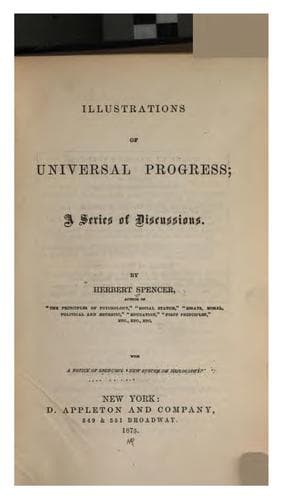
Illustrations of Universal Progress: A Series of DiscussionsSpencer, Herbert
Philosophy
Illustrations of Universal Progress: A Series of Discussions
Spencer, Herbert
Philosophy; Political science; Science
Every child has made the attempt to hold the foot still while it is
tickled, and has failed; and probably there is scarcely any one who has not
vainly tried to avoid winking, when a hand has been suddenly passed before
the eyes. These examples of muscular movements which occur independently of
the will, or in spite of it, illustrate what physiologists call
reflex-action; as likewise do sneezing and coughing. To this class of
cases, in which involuntary motions are accompanied by sensations, has to
be added another class of cases, in which involuntary motions are
unaccompanied by sensations:--instance the pulsations of the heart; the
contractions of the stomach during digestion. Further, the great mass of
seemingly-voluntary acts in such creatures as insects, worms, molluscs, are
considered by physiologists to be as purely automatic as is the dilatation
or closure of the iris under variations in quantity of light; and similarly
exemplify the law, that an impression on the end of an afferent nerve is
conveyed to some ganglionic centre, and is thence usually reflected along
an efferent nerve to one or more muscles which it causes to contract.
In a modified form this principle holds with voluntary acts. Nervous
excitation always _tends_ to beget muscular motion; and when it rises to a
certain intensity, always does beget it. Not only in reflex actions,
whether with or without sensation, do we see that special nerves, when
raised to a state of tension, discharge themselves on special muscles with
which they are indirectly connected; but those external actions through
which we read the feelings of others, show us that under any considerable
tension, the nervous system in general discharges itself on the muscular
system in general: either with or without the guidance of the will. The
shivering produced by cold, implies irregular muscular contractions, which,
though at first only partly involuntary, become, when the cold is extreme,
almost wholly involuntary. When you have severely burnt your finger, it is
very difficult to preserve a dignified composure: contortion of face, or
movement of limb, is pretty sure to follow. If a man receives good news
with neither change of feature nor bodily motion, it is inferred that he is
not much pleased, or that he has extraordinary self-control--either
inference implying that joy almost universally produces contraction of the
muscles; and so, alters the expression, or attitude, or both. And when we
hear of the feats of strength which men have performed when their lives
were at stake--when we read how, in the energy of despair, even paralytic
patients have regained for a time the use of their limbs; we see still more
clearly the relations between nervous and muscular excitements. It becomes
manifest both that emotions and sensations tend to generate bodily
movements, and that the movements are vehement in proportion as the
emotions or sensations are intense.[G]
Public-domain text, read in full here on John Shaqi.
Reviews
Reviews
No reviews yet
Be the first to share your thoughts on this work.
Elsewhere in the archive
Join the Discussion
Join the discussion
Sign in to leave a comment or review.
Sign InorCreate an account