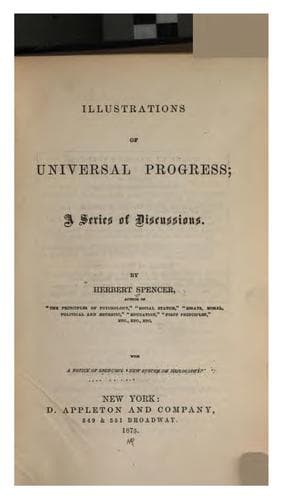
Illustrations of Universal Progress: A Series of DiscussionsSpencer, Herbert
Philosophy
Illustrations of Universal Progress: A Series of Discussions
Spencer, Herbert
Philosophy; Political science; Science
All know how generally a large amount of emotion disturbs the action of the
intellect, and interferes with the power of expression. A speech delivered
with great facility to tables and chairs, is by no means so easily
delivered to an audience. Every schoolboy can testify that his trepidation,
when standing before a master, has often disabled him from repeating a
lesson which he had duly learnt. In explanation of this we commonly say
that the attention is distracted--that the proper train of ideas is broken
by the intrusion of ideas that are irrelevant. But the question is, in what
manner does unusual emotion produce this effect; and we are here supplied
with a tolerably obvious answer. The repetition of a lesson, or set speech
previously thought out, implies the flow of a very moderate amount of
nervous excitement through a comparatively narrow channel. The thing to be
done is simply to call up in succession certain previously-arranged
ideas--a process in which no great amount of mental energy is expended.
Hence, when there is a large quantity of emotion, which must be discharged
in some direction or other; and when, as usually happens, the restricted
series of intellectual actions to be gone through, does not suffice to
carry it off; there result discharges along other channels besides the one
prescribed: there are aroused various ideas foreign to the train of thought
to be pursued; and these tend to exclude from consciousness those which
should occupy it.
And now observe the meaning of those bodily actions spontaneously set up
under these circumstances. The school-boy saying his lesson, commonly has
his fingers actively engaged--perhaps in twisting about a broken pen, or
perhaps squeezing the angle of his jacket; and if told to keep his hands
still, he soon again falls into the same or a similar trick. Many anecdotes
are current of public speakers having incurable automatic actions of this
class: barristers who perpetually wound and unwound pieces of tape; members
of parliament ever putting on and taking off their spectacles. So long as
such movements are unconscious, they facilitate the mental actions. At
least this seems a fair inference from the fact that confusion frequently
results from putting a stop to them: witness the case narrated by Sir
Walter Scott of his school-fellow, who became unable to say his lesson
after the removal of the waistcoat-button that he habitually fingered while
in class. But why do they facilitate the mental actions? Clearly because
they draw off a portion of the surplus nervous excitement. If, as above
explained, the quantity of mental energy generated is greater than can find
vent along the narrow channel of thought that is open to it; and if, in
consequence, it is apt to produce confusion by rushing into other channels
of thought; then by allowing it an exit through the motor nerves into the
muscular system, the pressure is diminished, and irrelevant ideas are less
likely to intrude on consciousness.
Public-domain text, read in full here on John Shaqi.
Reviews
Reviews
No reviews yet
Be the first to share your thoughts on this work.
Elsewhere in the archive
Join the Discussion
Join the discussion
Sign in to leave a comment or review.
Sign InorCreate an account