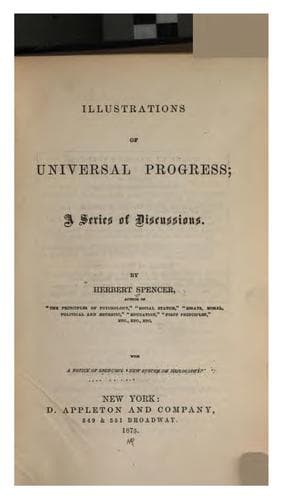
Illustrations of Universal Progress: A Series of DiscussionsSpencer, Herbert
Philosophy
Illustrations of Universal Progress: A Series of Discussions
Spencer, Herbert
Philosophy; Political science; Science
This further illustration will, I think, justify the position that
something may be achieved by pursuing in other cases this method of
psychological inquiry. A complete explanation of the phenomena, requires us
to trace out _all_ the consequences of any given state of consciousness;
and we cannot do this without studying the effects, bodily and mental, as
varying in quantity at each other's expense. We should probably learn much
if we in every case asked--Where is all the nervous energy gone?
V. THE ORIGIN AND FUNCTION OF MUSIC
When Carlo, standing, chained to his kennel, sees his master in the
distance, a slight motion of the tail indicates his but faint hope that he
is about to be let out. A much more decided wagging of the tail, passing
by-and-by into lateral undulations of the body, follows his master's nearer
approach. When hands are laid on his collar, and he knows that he is really
to have an outing, his jumping and wriggling are such that it is by no
means easy to loose his fastenings. And when he finds himself actually
free, his joy expends itself in bounds, in pirouettes, and in scourings
hither and thither at the top of his speed. Puss, too, by erecting her
tail, and by every time raising her back to meet the caressing hand of her
mistress, similarly expresses her gratification by certain muscular
actions; as likewise do the parrot by awkward dancing on his perch, and the
canary by hopping and fluttering about his cage with unwonted rapidity.
Under emotions of an opposite kind, animals equally display muscular
excitement. The enraged lion lashes his sides with his tail, knits his
brows, protrudes his claws. The cat sets up her back; the dog retracts his
upper lip; the horse throws back his ears. And in the struggles of
creatures in pain, we see that the like relation holds between excitement
of the muscles and excitement of the nerves of sensation.
In ourselves, distinguished from lower creatures as we are by feelings
alike more powerful and more varied, parallel facts are at once more
conspicuous and more numerous. We may conveniently look at them in groups.
We shall find that pleasurable sensations and painful sensations,
pleasurable emotions and painful emotions, all tend to produce active
demonstrations in proportion to their intensity.
In children, and even in adults who are not restrained by regard for
appearances, a highly agreeable taste is followed by a smacking of the
lips. An infant will laugh and bound in its nurse's arms at the sight of a
brilliant colour or the hearing of a new sound. People are apt to beat time
with head or feet to music which particularly pleases them. In a sensitive
person an agreeable perfume will produce a smile; and smiles will be seen
on the faces of a crowd gazing at some splendid burst of fireworks. Even
the pleasant sensation of warmth felt on getting to the fireside out of a
winter's storm, will similarly express itself in the face.
Public-domain text, read in full here on John Shaqi.
Reviews
Reviews
No reviews yet
Be the first to share your thoughts on this work.
Elsewhere in the archive
Join the Discussion
Join the discussion
Sign in to leave a comment or review.
Sign InorCreate an account