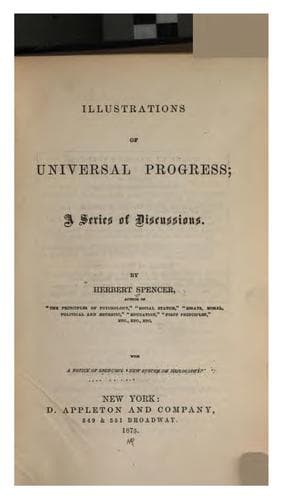
Illustrations of Universal Progress: A Series of DiscussionsSpencer, Herbert
Philosophy
Illustrations of Universal Progress: A Series of Discussions
Spencer, Herbert
Philosophy; Political science; Science
Painful sensations, being mostly far more intense than pleasurable ones,
cause muscular actions of a much more decided kind. A sudden twinge
produces a convulsive start of the whole body. A pain less violent, but
continuous, is accompanied by a knitting of the brows, a setting of the
teeth or biting of the lip, and a contraction of the features generally.
Under a persistent pain of a severer kind, other muscular actions are
added: the body is swayed to and fro; the hands clench anything they can
lay hold of; and should the agony rise still higher, the sufferer rolls
about on the floor almost convulsed.
Though more varied, the natural language of the pleasurable emotions comes
within the same generalization. A smile, which is the commonest expression
of gratified feeling, is a contraction of certain facial muscles; and when
the smile broadens into a laugh, we see a more violent and more general
muscular excitement produced by an intenser gratification. Rubbing together
of the hands, and that other motion which Dickens somewhere describes as
"washing with impalpable soap in invisible water," have like implications.
Children may often be seen to "jump for joy." Even in adults of excitable
temperament, an action approaching to it is sometimes witnessed. And
dancing has all the world through been regarded as natural to an elevated
state of mind. Many of the special emotions show themselves in special
muscular actions. The gratification resulting from success, raises the head
and gives firmness to the gait. A hearty grasp of the hand is currently
taken as indicative of friendship. Under a gush of affection the mother
clasps her child to her breast, feeling as though she could squeeze it to
death. And so in sundry other cases. Even in that brightening of the eye
with which good news is received we may trace the same truth; for this
appearance of greater brilliancy is due to an extra contraction of the
muscle which raises the eyelid, and so allows more light to fall upon, and
be reflected from, the wet surface of the eyeball.
Public-domain text, read in full here on John Shaqi.
Reviews
Reviews
No reviews yet
Be the first to share your thoughts on this work.
Elsewhere in the archive
Join the Discussion
Join the discussion
Sign in to leave a comment or review.
Sign InorCreate an account