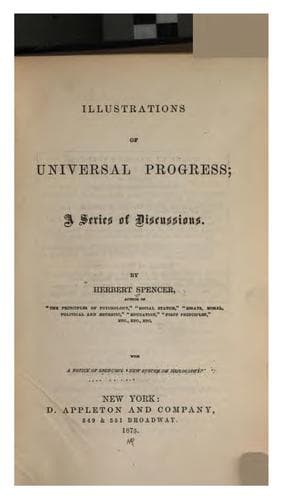
Illustrations of Universal Progress: A Series of DiscussionsSpencer, Herbert
Philosophy
Illustrations of Universal Progress: A Series of Discussions
Spencer, Herbert
Philosophy; Political science; Science
Besides these chief characteristics of song as distinguished from common
speech, there are sundry minor ones similarly explicable as due to the
relation between mental and muscular excitement; and before proceeding
further, these should be briefly noticed. Thus, certain passions, and
perhaps all passions when pushed to an extreme, produce (probably through
their influence over the action of the heart) an effect the reverse of that
which has been described: they cause a physical prostration, one symptom of
which is a general relaxation of the muscles, and a consequent trembling.
We have the trembling of anger, of fear, of hope, of joy; and the vocal
muscles being implicated with the rest, the voice too becomes tremulous.
Now, in singing, this tremulousness of voice is very effectively used by
some vocalists in highly pathetic passages; sometimes, indeed, because of
its effectiveness, too much used by them--as by Tamberlik, for instance.
Again, there is a mode of musical execution known as the _staccato_,
appropriate to energetic passages--to passages expressive of exhilaration,
of resolution, of confidence. The action of the vocal muscles which
produces this staccato style, is analogous to the muscular action which
produces the sharp, decisive, energetic movements of body indicating these
states of mind; and therefore it is that the staccato style has the meaning
we ascribe to it. Conversely, slurred intervals are expressive of gentler
and less active feelings; and are so because they imply the smaller
muscular vivacity due to a lower mental energy. The difference of effect
resulting from difference of _time_ in music, is also attributable to the
same law. Already it has been pointed out that the more frequent changes of
pitch which ordinarily result from passion, are imitated and developed in
song; and here we have to add, that the various rates of such changes,
appropriate to the different styles of music, are further traits having the
same derivation. The slowest movements, _largo_ and _adagio_, are used
where such depressing emotions as grief, or such unexciting emotions as
reverence, are to be portrayed; while the more rapid movements, _andante_,
_allegro_, _presto_, represent successively increasing degrees of mental
vivacity; and do this because they imply that muscular activity which flows
from this mental vivacity. Even the _rhythm_, which forms a remaining
distinction between song and speech, may not improbably have a kindred
cause. Why the actions excited by strong feeling should tend to become
rhythmical, is not very obvious; but that they do so there are divers
evidences. There is the swaying of the body to and fro under pain or grief,
of the leg under impatience or agitation. Dancing, too, is a rhythmical
action natural to elevated emotion. That under excitement speech acquires a
certain rhythm, we may occasionally perceive in the highest efforts of an
orator. In poetry, which is a form of speech used for the better expression
Public-domain text, read in full here on John Shaqi.
Reviews
Reviews
No reviews yet
Be the first to share your thoughts on this work.
Elsewhere in the archive
Join the Discussion
Join the discussion
Sign in to leave a comment or review.
Sign InorCreate an account