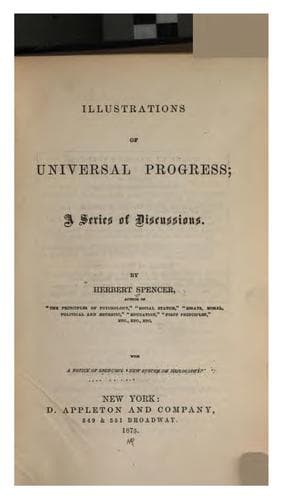
Illustrations of Universal Progress: A Series of DiscussionsSpencer, Herbert
Philosophy
Illustrations of Universal Progress: A Series of Discussions
Spencer, Herbert
Philosophy; Political science; Science
of emotional ideas, we have this rhythmical tendency developed. And when we
bear in mind that dancing, poetry, and music are connate--are originally
constituent parts of the same thing, it becomes clear that the measured
movement common to them all implies a rhythmical action of the whole
system, the vocal apparatus included; and that so the rhythm of music is a
more subtle and complex result of this relation between mental and muscular
excitement.
But it is time to end this analysis, which, possibly we have already
carried too far. It is not to be supposed that the more special
peculiarities of musical expression are to be definitely explained. Though
probably they may all in some way conform to the principle that has been
worked out, it is obviously impracticable to trace that principle in its
more ramified applications. Nor is it needful to our argument that it
should be so traced. The foregoing facts sufficiently prove that what we
regard as the distinctive traits of song, are simply the traits of
emotional speech intensified and systematized. In respect of its general
characteristics, we think it has been made clear that vocal music, and by
consequence all music, is an idealization of the natural language of
passion.
* * * * *
As far as it goes, the scanty evidence furnished by history confirms this
conclusion. Note first the fact (not properly an historical one, but fitly
grouped with such) that the dance-chants of savage tribes are very
monotonous; and in virtue of their monotony are much more nearly allied to
ordinary speech than are the songs of civilized races. Joining with this
the fact that there are still extant among boatmen and others in the East,
ancient chants of a like monotonous character, we may infer that vocal
music originally diverged from emotional speech in a gradual, unobtrusive
manner; and this is the inference to which our argument points. Further
evidence to the same effect is supplied by Greek history. The early poems
of the Greeks--which, be it remembered, were sacred legends embodied in
that rhythmical, metaphorical language which strong feeling excites--were
not recited, but chanted: the tones and the cadences were made musical by
the same influences which made the speech poetical.
Public-domain text, read in full here on John Shaqi.
Reviews
Reviews
No reviews yet
Be the first to share your thoughts on this work.
Elsewhere in the archive
Join the Discussion
Join the discussion
Sign in to leave a comment or review.
Sign InorCreate an account