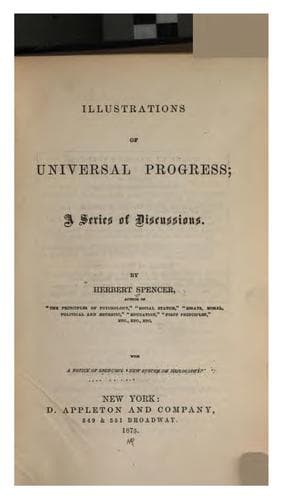
Illustrations of Universal Progress: A Series of DiscussionsSpencer, Herbert
Philosophy
Illustrations of Universal Progress: A Series of Discussions
Spencer, Herbert
Philosophy; Political science; Science
Not only may we so understand how more sonorous tones, greater extremes of
pitch, and wider intervals, were gradually introduced; but also how there
arose a greater variety and complexity of musical expression. For this same
passionate, enthusiastic temperament, which naturally leads the musical
composer to express the feelings possessed by others as well as himself, in
extremer intervals and more marked cadences than they would use, also leads
him to give musical utterance to feelings which they either do not
experience, or experience in but slight degrees. In virtue of this general
susceptibility which distinguishes him, he regards with emotion, events,
scenes, conduct, character, which produce upon most men no appreciable
effect. The emotions so generated, compounded as they are of the simpler
emotions, are not expressible by intervals and cadences natural to these,
but by combinations of such intervals and cadences: whence arise more
involved musical phrases, conveying more complex, subtle, and unusual
feelings. And thus we may in some measure understand how it happens that
music not only so strongly excites our more familiar feelings, but also
produces feelings we never had before--arouses dormant sentiments of which
we had not conceived the possibility and do not know the meaning; or, as
Richter says--tells us of things we have not seen and shall not see.
* * * * *
Indirect evidences of several kinds remain to be briefly pointed out. One
of them is the difficulty, not to say impossibility, of otherwise
accounting for the expressiveness of music. Whence comes it that special
combinations of notes should have special effects upon our emotions?--that
one should give us a feeling of exhilaration, another of melancholy,
another of affection, another of reverence? Is it that these special
combinations have intrinsic meanings apart from the human
constitution?--that a certain number of aerial waves per second, followed
by a certain other number, in the nature of things signify grief, while in
the reverse order they signify joy; and similarly with all other intervals,
phrases, and cadences? Few will be so irrational as to think this. Is it,
then, that the meanings of these special combinations are conventional
only?--that we learn their implications, as we do those of words, by
observing how others understand them? This is an hypothesis not only devoid
of evidence, but directly opposed to the experience of every one. How,
then, are musical effects to be explained? If the theory above set forth be
accepted, the difficulty disappears. If music, taking for its raw material
the various modifications of voice which are the physiological results of
excited feeling, intensifies, combines, and complicates them--if it
exaggerates the loudness, the resonance, the pitch, the intervals, and the
variability, which, in virtue of an organic law, are the characteristics of
Public-domain text, read in full here on John Shaqi.
Reviews
Reviews
No reviews yet
Be the first to share your thoughts on this work.
Elsewhere in the archive
Join the Discussion
Join the discussion
Sign in to leave a comment or review.
Sign InorCreate an account