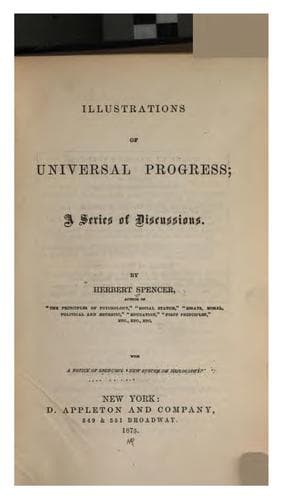
Illustrations of Universal Progress: A Series of DiscussionsSpencer, Herbert
Philosophy
Illustrations of Universal Progress: A Series of Discussions
Spencer, Herbert
Philosophy; Political science; Science
passionate speech--if, by carrying out these further, more consistently,
more unitedly, and more sustainedly, it produces an idealized language of
emotion; then its power over us becomes comprehensible. But in the absence
of this theory, the expressiveness of music appears to be inexplicable.
Again, the preference we feel for certain qualities of sound presents a
like difficulty, admitting only of a like solution. It is generally agreed
that the tones of the human voice are more pleasing than any others. Grant
that music takes its rise from the modulations of the human voice under
emotion, and it becomes a natural consequence that the tones of that voice
should appeal to our feelings more than any others; and so should be
considered more beautiful than any others. But deny that music has this
origin, and the only alternative is the untenable position that the
vibrations proceeding from a vocalist's throat are, objectively considered,
of a higher order than those from a horn or a violin. Similarly with harsh
and soft sounds. If the conclusiveness of the foregoing reasonings be not
admitted, it must be supposed that the vibrations causing the last are
intrinsically better than those causing the first; and that, in virtue of
some pre-established harmony, the higher feelings and natures produce the
one, and the lower the other. But if the foregoing reasonings be valid, it
follows, as a matter of course, that we shall like the sounds that
habitually accompany agreeable feelings, and dislike those that habitually
accompany disagreeable feelings.
Once more, the question--How is the expressiveness of music to be otherwise
accounted for? may be supplemented by the question--How is the genesis of
music to be otherwise accounted for? That music is a product of
civilization is manifest; for though savages have their dance-chants, these
are of a kind scarcely to be dignified by the title musical: at most, they
supply but the vaguest rudiment of music, properly so called. And if music
has been by slow steps developed in the course of civilization, it must
have been developed out of something. If, then, its origin is not that
above alleged, what is its origin?
Public-domain text, read in full here on John Shaqi.
Reviews
Reviews
No reviews yet
Be the first to share your thoughts on this work.
Elsewhere in the archive
Join the Discussion
Join the discussion
Sign in to leave a comment or review.
Sign InorCreate an account