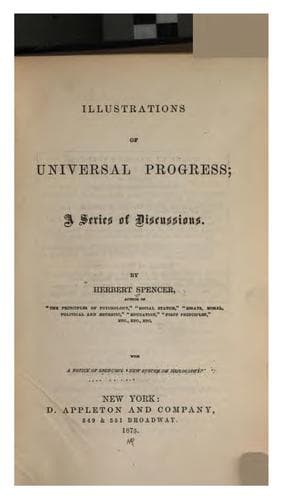
Illustrations of Universal Progress: A Series of DiscussionsSpencer, Herbert
Philosophy
Illustrations of Universal Progress: A Series of Discussions
Spencer, Herbert
Philosophy; Political science; Science
Thus we find that the negative evidence confirms the positive, and that,
taken together, they furnish strong proof. We have seen that there is a
physiological relation, common to man and all animals, between feeling and
muscular action; that as vocal sounds are produced by muscular action,
there is a consequent physiological relation between feeling and vocal
sounds; that all the modifications of voice expressive of feeling are the
direct results of this physiological relation; that music, adopting all
these modifications, intensifies them more and more as it ascends to its
higher and higher forms, and becomes music simply in virtue of thus
intensifying them; that, from the ancient epic poet chanting his verses,
down to the modern musical composer, men of unusually strong feelings prone
to express them in extreme forms, have been naturally the agents of these
successive intensifications; and that so there has little by little arisen
a wide divergence between this idealized language of emotion and its
natural language: to which direct evidence we have just added the
indirect--that on no other tenable hypothesis can either the expressiveness
or the genesis of music be explained.
* * * * *
And now, what is the _function_ of music? Has music any effect beyond the
immediate pleasure it produces? Analogy suggests that it has. The
enjoyments of a good dinner do not end with themselves, but minister to
bodily well-being. Though people do not marry with a view to maintain the
race, yet the passions which impel them to marry secure its maintenance.
Parental affection is a feeling which, while it conduces to parental
happiness, ensures the nurture of offspring. Men love to accumulate
property, often without thought of the benefits it produces; but in
pursuing the pleasure of acquisition they indirectly open the way to other
pleasures. The wish for public approval impels all of us to do many things
which we should otherwise not do,--to undertake great labours, face great
dangers, and habitually rule ourselves in a way that smooths social
intercourse: that is, in gratifying our love of approbation we subserve
divers ulterior purposes. And, generally, our nature is such that in
fulfilling each desire, we in some way facilitate the fulfilment of the
rest. But the love of music seems to exist for its own sake. The delights
of melody and harmony do not obviously minister to the welfare either of
the individual or of society. May we not suspect, however, that this
exception is apparent only? Is it not a rational inquiry--What are the
indirect benefits which accrue from music, in addition to the direct
pleasure it gives?
Public-domain text, read in full here on John Shaqi.
Reviews
Reviews
No reviews yet
Be the first to share your thoughts on this work.
Elsewhere in the archive
Join the Discussion
Join the discussion
Sign in to leave a comment or review.
Sign InorCreate an account