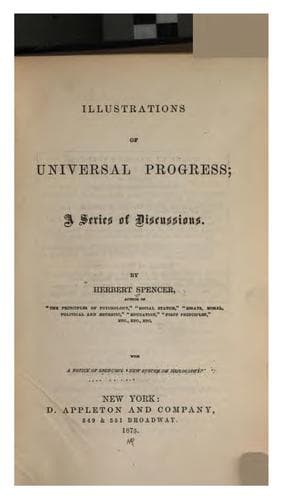
Illustrations of Universal Progress: A Series of Discussions — John Shaqi
Illustrations of Universal Progress: A Series of DiscussionsSpencer, Herbert
Philosophy
Illustrations of Universal Progress: A Series of Discussions
Spencer, Herbert
Philosophy; Political science; Science
Passing from this hypothetical illustration, which must be taken for what
it is worth, without prejudice to the general argument, let us descend to a
more certain order of evidence. It is now generally agreed among geologists
that the Earth was at first a mass of molten matter; and that it is still
fluid and incandescent at the distance of a few miles beneath its surface.
Originally, then, it was homogeneous in consistence, and, in virtue of the
circulation that takes place in heated fluids, must have been comparatively
homogeneous in temperature; and it must have been surrounded by an
atmosphere consisting partly of the elements of air and water, and partly
of those various other elements which assume a gaseous form at high
temperatures. That slow cooling by radiation which is still going on at an
inappreciable rate, and which, though originally far more rapid than now,
necessarily required an immense time to produce any decided change, must
ultimately have resulted in the solidification of the portion most able to
part with its heat--namely, the surface. In the thin crust thus formed we
have the first marked differentiation. A still further cooling, a
consequent thickening of this crust, and an accompanying deposition of all
solidifiable elements contained in the atmosphere, must finally have been
followed by the condensation of the water previously existing as vapour. A
second marked differentiation must thus have arisen: and as the
condensation must have taken place on the coolest parts of the
surface--namely, about the poles--there must thus have resulted the first
geographical distinction of parts. To these illustrations of growing
heterogeneity, which, though deduced from the known laws of matter, may be
regarded as more or less hypothetical, Geology adds an extensive series
that have been inductively established. Its investigations show that the
Earth has been continually becoming more heterogeneous in virtue of the
multiplication of the strata which form its crust; further, that it has
been becoming more heterogeneous in respect of the composition of these
strata, the latter of which, being made from the detritus of the older
ones, are many of them rendered highly complex by the mixture of materials
they contain; and that this heterogeneity has been vastly increased by the
action of the Earth's still molten nucleus upon its envelope, whence have
resulted not only a great variety of igneous rocks, but the tilting up of
sedimentary strata at all angles, the formation of faults and metallic
veins, the production of endless dislocations and irregularities. Yet
again, geologists teach us that the Earth's surface has been growing more
varied in elevation--that the most ancient mountain systems are the
smallest, and the Andes and Himalayas the most modern; while in all
probability there have been corresponding changes in the bed of the ocean.
As a consequence of these ceaseless differentiations, we now find that no
Public-domain text, read in full here on John Shaqi.
Reviews
Reviews
No reviews yet
Be the first to share your thoughts on this work.
Join the Discussion
Join the discussion
Sign in to leave a comment or review.
Sign InorCreate an account