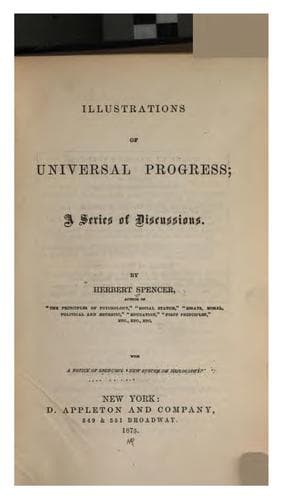
Illustrations of Universal Progress: A Series of DiscussionsSpencer, Herbert
Philosophy
Illustrations of Universal Progress: A Series of Discussions
Spencer, Herbert
Philosophy; Political science; Science
[L] It is true that, as expressed by him, these propositions of
Laplace are not all beyond dispute. An astronomer of the highest
authority, who has favoured me with some criticisms on this
essay, alleges that instead of a nebulous ring rupturing at one
point, and collapsing into a single mass, "all probability would
be in favour of its breaking up into many masses." This
alternative result certainly seems to be more likely. But
granting that a nebulous ring would break up into many masses, it
may still be contended that, since the chances are infinity to
one against these being of equal sizes and equidistant, they
could not remain evenly distributed round their orbit: this
annular chain of gaseous masses would break up into groups of
masses; these groups would eventually aggregate into larger
groups; and the final result would be the formation of a single
mass. I have put the question to an astronomer scarcely second in
authority to the one above referred to, and he agrees that this
would probably be the process.
But now let us inquire whether, besides these most conspicuous
peculiarities of the Solar System, sundry minor ones are not similarly
explicable. Take first the relation between the planes of the planetary
orbits and the plane of the sun's equator. If, when the nebulous spheroid
extended beyond the orbit of Neptune, all parts of it had been revolving
exactly in the same plane or rather in parallel planes--if all its parts
had had one axis; then the planes of the successive rings would have been
coincident with each other and with that of the sun's rotation. But it
needs only to go back to the earlier stages of concentration, to see that
there could exist no such complete uniformity of motion. The flocculi,
already described as precipitated from an irregular and widely-diffused
nebula, and as starting from all points to their common centre of gravity,
must move not in one plane but in innumerable planes, cutting each other at
all angles.
Public-domain text, read in full here on John Shaqi.
Reviews
Reviews
No reviews yet
Be the first to share your thoughts on this work.
Elsewhere in the archive
Join the Discussion
Join the discussion
Sign in to leave a comment or review.
Sign InorCreate an account