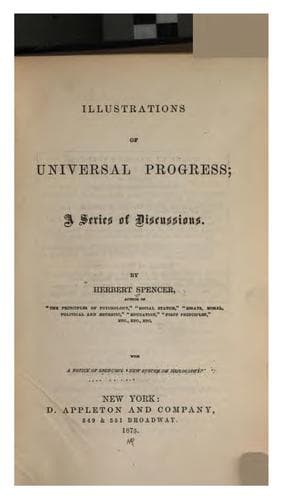
Illustrations of Universal Progress: A Series of DiscussionsSpencer, Herbert
Philosophy
Illustrations of Universal Progress: A Series of Discussions
Spencer, Herbert
Philosophy; Political science; Science
The gradual establishment of a vortical motion such as we saw must
eventually arise, and such as we at present see indicated in the spiral
nebulae, is the gradual approach toward motion in one plane--the plane of
greatest momentum. But this plane can only slowly become decided. Flocculi
not moving in this plane, but entering into the aggregation at various
inclinations, will tend to perform their revolutions round its centre in
their own planes; and only in course of time will their motions be partly
destroyed by conflicting ones, and partly resolved into the general motion.
Especially will the outermost portions of the rotating mass retain for long
time their more or less independent directions; seeing that neither by
friction nor by the central forces will they be so much restrained. Hence
the probabilities are, that the planes of the rings first detached will
differ considerably from the average plane of the mass; while the planes of
those detached latest will differ from it less. Here, again, inference to a
considerable extent agrees with observation. Though the progression is
irregular, yet on the average the inclinations decrease on approaching the
sun.
Consider next the movements of the planets on their axes. Laplace alleged
as one among other evidences of a common genetic cause, that the planets
rotate in a direction the same as that in which they go round the sun, and
on axes approximately perpendicular to their orbits. Since he wrote, an
exception to this general rule has been discovered in the case of Uranus,
and another still more recently in the case of Neptune--judging, at least,
from the motions of their respective satellites. This anomaly has been
thought to throw considerable doubt on his speculation; and at first sight
it does so. But a little reflection will, we believe, show that the anomaly
is by no means an insoluble one; and that Laplace simply went too far in
putting down as a certain result of nebular genesis, what is, in some
instances, only a probable result. The cause he pointed out as determining
the direction of rotation, is the greater absolute velocity of the outer
part of the detached ring. But there are conditions under which this
difference of velocity may be relatively insignificant, even if it exists:
and others in which, though existing to a considerable extent, it will not
suffice to determine the direction of rotation.
Public-domain text, read in full here on John Shaqi.
Reviews
Reviews
No reviews yet
Be the first to share your thoughts on this work.
Elsewhere in the archive
Join the Discussion
Join the discussion
Sign in to leave a comment or review.
Sign InorCreate an account