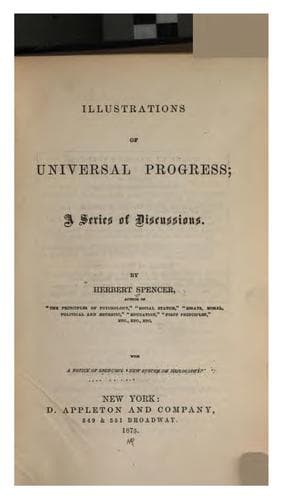
Illustrations of Universal Progress: A Series of DiscussionsSpencer, Herbert
Philosophy
Illustrations of Universal Progress: A Series of Discussions
Spencer, Herbert
Philosophy; Political science; Science
On the common theory of creation, these phenomena are inexplicable. To what
end the Earth should once have existed in a molten state, incapable of
supporting life, it cannot say. To satisfy this supposition, the Earth
should have been originally created in a state fit for the assumed purposes
of creation; and similarly with the other planets. While, therefore, to the
Nebular Hypothesis the evidence of original incandescence and still
continued internal heat, furnish strong confirmation, they are, to the
antagonist hypothesis, insurmountable difficulties.
But the argument from temperature does not end here. There remains to be
noticed a more conspicuous and still more significant fact. If the Solar
System was formed by the concentration of diffused matter, which evolved
heat while gravitating into its present dense form; then there are certain
obvious corollaries respecting the relative temperatures of the resulting
bodies. Other things equal, the latest-formed mass will be the latest in
cooling--will, for an almost infinite time, possess a greater heat than the
earlier-formed ones. Other things equal, the largest mass will, because of
its superior aggregative force, become hotter than the others, and radiate
more intensely. Other things equal, the largest mass, notwithstanding the
higher temperature it reaches, will, in consequence of its relatively small
surface, be the slowest in losing its evolved heat. And hence, if there is
one mass which was not only formed after the rest, but exceeds them
enormously in size, it follows that this one will reach an intensity of
incandescence much beyond that reached by the rest; and will continue in a
state of intense incandescence long after the rest have cooled.
Such a mass we have in the Sun. It is a corollary from the Nebular
Hypothesis, that the matter forming the Sun assumed its present concrete
form, at a period much more recent than that at which the planets became
definite bodies. The quantity of matter contained in the Sun is nearly five
million times that contained in the smallest planet, and above a thousand
times that contained in the largest. And while, from the enormous
gravitative force of the atoms, the evolution of heat has been intense, the
facilities of radiation have been relatively small. Hence the
still-continued high temperature. Just that condition of the central body
which is a necessary inference from the Nebular Hypothesis, we find
actually existing in the Sun.
Public-domain text, read in full here on John Shaqi.
Reviews
Reviews
No reviews yet
Be the first to share your thoughts on this work.
Elsewhere in the archive
Join the Discussion
Join the discussion
Sign in to leave a comment or review.
Sign InorCreate an account