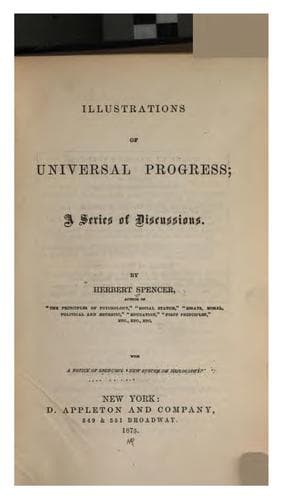
Illustrations of Universal Progress: A Series of DiscussionsSpencer, Herbert
Philosophy
Illustrations of Universal Progress: A Series of Discussions
Spencer, Herbert
Philosophy; Political science; Science
It may be well to consider a little more closely, what is the probable
condition of the Sun's surface. Round the globe of incandescent molten
substances, thus conceived to form the visible body of the Sun, there is
known to exist a voluminous atmosphere: the inferior brilliancy of the
Sun's border, and the appearances during a total eclipse, alike show
this.[S] What now must be the constitution of this atmosphere? At a
temperature approaching a thousand times that of molten iron, which is the
calculated temperature of the solar surface, very many, if not all, of the
substances we know as solid, would become gaseous; and though the Sun's
enormous attractive force must be a powerful check on this tendency to
assume the form of vapour, yet it cannot be questioned that if the body of
the Sun consists of molten substances, some of them must be constantly
undergoing evaporation. That the dense gases thus continually being
generated will form the entire mass of the solar atmosphere, is not
probable. If anything is to be inferred, either from the Nebular
Hypothesis, or from the analogies supplied by the planets, it must be
concluded that the outermost part of the solar atmosphere consists of what
are called permanent gases--gases that are not condensible into fluid even
at low temperatures. If we consider what must have been the state of things
here, when the surface of the Earth was molten, we shall see that round the
still molten surface of the Sun, there probably exists a stratum of dense
aeriform matter, made up of sublimed metals and metallic compounds, and
above this a stratum of comparatively rare medium analogous to air. What
now will happen with these two strata? Did they both consist of permanent
gases, they could not remain separate: according to a well-known law, they
would eventually form a homogeneous mixture. But this will by no means
happen when the lower stratum consists of matters that are gaseous only at
excessively high temperatures. Given off from a molten surface, ascending,
expanding, and cooling, these will presently reach a limit of elevation
above which they cannot exist as vapour, but must condense and precipitate.
Meanwhile the upper stratum, habitually charged with its quantum of these
denser matters, as our air with its quantum of water, and ready to deposit
them on any depression of temperature, must be habitually unable to take up
any more of the lower stratum; and therefore this lower stratum will remain
quite distinct from it.
[S] See Herschel's "Outlines of Astronomy."
Public-domain text, read in full here on John Shaqi.
Reviews
Reviews
No reviews yet
Be the first to share your thoughts on this work.
Elsewhere in the archive
Join the Discussion
Join the discussion
Sign in to leave a comment or review.
Sign InorCreate an account