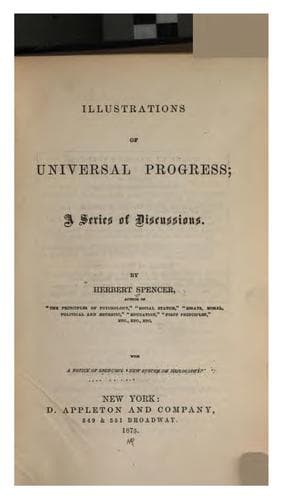
Illustrations of Universal Progress: A Series of DiscussionsSpencer, Herbert
Philosophy
Illustrations of Universal Progress: A Series of Discussions
Spencer, Herbert
Philosophy; Political science; Science
This reaction and subsequent re-reaction, well illustrate the recent
history of English thought in general. The time was when our countrymen
speculated, certainly to as great an extent as any other people, on all
those high questions which present themselves to the human intellect; and,
indeed, a glance at the systems of philosophy that are or have been current
on the Continent, suffices to show how much other nations owe to the
discoveries of our ancestors. For a generation or two, however, these more
abstract subjects have fallen into neglect; and, among those who plume
themselves on being "practical," even into contempt. Partly, perhaps, a
natural accompaniment of our rapid material growth, this intellectual phase
has been in great measure due to the exhaustion of argument, and the
necessity for better data. Not so much with a conscious recognition of the
end to be subserved, as from an unconscious subordination to that rhythm
traceable in social changes as in other things, an era of theorizing
without observing, has been followed by an era of observing without
theorizing. During the long-continued devotion to concrete science, an
immense quantity of raw material for abstract science has been accumulated;
and now there is obviously commencing a period in which this accumulated
raw material will be organized into consistent theory. On all
sides--equally in the inorganic sciences, in the science of life, and in
the science of society--may we note the tendency to pass from the
superficial and empirical to the more profound and rational.
In Psychology this change is conspicuous. The facts brought to light by
anatomists and physiologists during the last fifty years, are at length
being used towards the interpretation of this highest class of biological
phenomena; and already there is promise of a great advance. The work of Mr.
Alexander Bain, of which the second volume has been recently issued, may be
regarded as especially characteristic of the transition. It gives us in
orderly arrangement, the great mass of evidence supplied by modern science
towards the building-up of a coherent system of mental philosophy. It is
not in itself a system of mental philosophy, properly so called; but a
classified collection of materials for such a system, presented with that
method and insight which scientific discipline generates, and accompanied
with occasional passages of an analytical character. It is indeed that
which it in the main professes to be--a natural history of the mind.
Public-domain text, read in full here on John Shaqi.
Reviews
Reviews
No reviews yet
Be the first to share your thoughts on this work.
Elsewhere in the archive
Join the Discussion
Join the discussion
Sign in to leave a comment or review.
Sign InorCreate an account