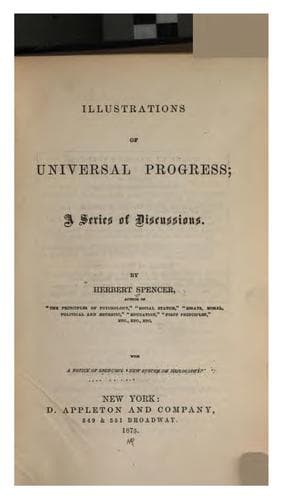
Illustrations of Universal Progress: A Series of DiscussionsSpencer, Herbert
Philosophy
Illustrations of Universal Progress: A Series of Discussions
Spencer, Herbert
Philosophy; Political science; Science
Were we to say that the researches of the naturalist who collects and
dissects and describes species, bear the same relation to the researches of
the comparative anatomist tracing out the laws of organization, which Mr.
Bain's labours bear to the labours of the abstract psychologist, we should
be going somewhat too far; for Mr. Bain's work is not wholly descriptive.
Still, however, such an analogy conveys the best general conception of what
he has done; and serves most clearly to indicate its needfulness. For as,
before there can be made anything like true generalizations respecting the
classification of organisms and the laws of organization, there must be an
extensive accumulation of the facts presented in numerous organic bodies;
so, without a tolerably-complete delineation of mental phenomena of all
orders, there can scarcely arise any adequate theory of the mind. Until
recently, mental science has been pursued much as physical science was
pursued by the ancients: not by drawing conclusions from observations and
experiments, but by drawing them from arbitrary a priori assumptions. This
course, long since abandoned in the one case with immense advantage, is
gradually being abandoned in the other; and the treatment of Psychology as
a division of natural history, shows that the abandonment will soon be
complete.
Estimated as a means to higher results, Mr. Bain's work is of great value.
Of its kind it is the most scientific in conception, the most catholic in
spirit, and the most complete in execution. Besides delineating the various
classes of mental phenomena as seen under that stronger light thrown on
them by modern science, it includes in the picture much which previous
writers had omitted--partly from prejudice, partly from ignorance. We refer
more especially to the participation of bodily organs in mental changes;
and the addition to the primary mental changes, of those many secondary
ones which the actions of the bodily organs generate. Mr. Bain has, we
believe, been the first to appreciate the importance of this element in our
states of consciousness; and it is one of his merits that he shows how
constant and large an element it is. Further, the relations of voluntary
and involuntary movements are elucidated in a way that was not possible to
writers unacquainted with the modern doctrine of reflex action. And beyond
this, some of the analytical passages that here and there occur, contain
important ideas.
Public-domain text, read in full here on John Shaqi.
Reviews
Reviews
No reviews yet
Be the first to share your thoughts on this work.
Elsewhere in the archive
Join the Discussion
Join the discussion
Sign in to leave a comment or review.
Sign InorCreate an account