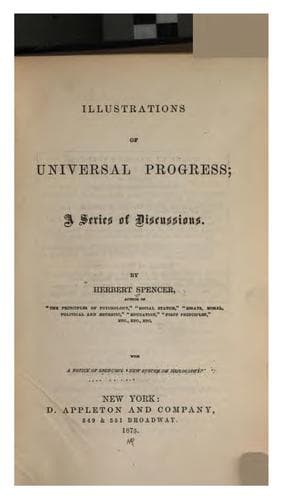
Illustrations of Universal Progress: A Series of DiscussionsSpencer, Herbert
Philosophy
Illustrations of Universal Progress: A Series of Discussions
Spencer, Herbert
Philosophy; Political science; Science
Though not avowedly, yet by implication, Mr. Bain assumes that a right
conception of the nature, the order, and the relations of the emotions, may
be arrived at by contemplating their conspicuous objective and subjective
characters, as displayed in the adult. After pointing out that we lack
those means of classification which serve in the case of the sensations, he
says--
"In these circumstances we must turn our attention to _the manner
of diffusion_ of the different passions and emotions, in order to
obtain a basis of classification analogous to the arrangement of the
sensations. If what we have already advanced on that subject be at
all well founded, this is the genuine turning point of the method to
be chosen, for the same mode of diffusion will always be accompanied
by the same mental experience, and each of the two aspects would
identify, and would be evidence of, the other. There is, therefore,
nothing so thoroughly characteristic of any state of feeling as the
nature of the diffusive wave that embodies it, or the various organs
specially roused into action by it, together with the manner of the
action. The only drawback is our comparative ignorance, and our
inability to discern the precise character of the diffusive currents
in every case; a radical imperfection in the science of mind as
constituted at present.
"Our own consciousness, formerly reckoned the only medium of
knowledge to the mental philosopher, must therefore be still referred
to as a principal means of discriminating the varieties of human
feeling. We have the power of noting agreement and difference among
our conscious states, and on this we can raise a structure of
classification. We recognise such generalities as pleasure, pain,
love, anger, through the property of mental or intellectual
discrimination that accompanies in our mind the fact of an emotion. A
certain degree of precision is attainable by this mode of mental
comparison and analysis; the farther we can carry such precision the
better; but that is no reason why it should stand alone to the
neglect of the corporeal embodiments through which one mind reveals
itself to others. The companionship of inward feeling with bodily
manifestation is a fact of the human constitution, and deserves to be
studied as such; and it would be difficult to find a place more
appropriate than a treatise on the mind for setting forth the
conjunctions and sequences traceable in this department of nature. I
shall make no scruple in conjoining with the description of the
mental phenomena the physical appearances, in so far as I am able to
ascertain them.
Public-domain text, read in full here on John Shaqi.
Reviews
Reviews
No reviews yet
Be the first to share your thoughts on this work.
Elsewhere in the archive
Join the Discussion
Join the discussion
Sign in to leave a comment or review.
Sign InorCreate an account