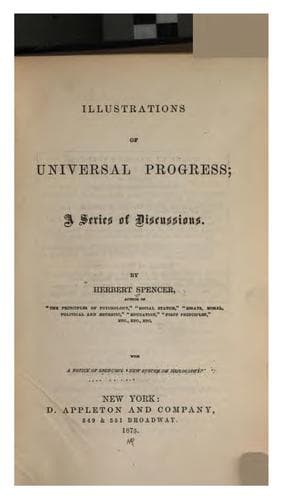
Illustrations of Universal Progress: A Series of DiscussionsSpencer, Herbert
Philosophy
Illustrations of Universal Progress: A Series of Discussions
Spencer, Herbert
Philosophy; Political science; Science
Valuable, however, as is Mr. Bain's work, we regard it as essentially
transitional. It presents in a digested form the results of a period of
observation; adds to these results many well-delineated facts collected by
himself; arranges new and old materials with that more scientific method
which the discipline of our times has fostered; and so prepare the way for
better generalizations. But almost of necessity its classifications and
conclusions are provisional. In the growth of each science, not only is
correct observation needful for the formation of true theory; but true
theory is needful as a preliminary to correct observation. Of course we do
not intend this assertion to be taken literally; but as a strong expression
of the fact that the two must advance hand in hand. The first crude theory
or rough classification, based on very slight knowledge of the phenomena,
is requisite as a means of reducing the phenomena to some kind of order;
and as supplying a conception with which fresh phenomena may be compared,
and their agreement or disagreement noted. Incongruities being by and by
made manifest by wider examination of cases, there comes such modification
of the theory as brings it into a nearer correspondence with the evidence.
This reacts to the further advance of observation. More extensive and
complete observation brings additional corrections of theory. And so on
till the truth is reached. In mental science, the systematic collection of
facts having but recently commenced, it is not to be expected that the
results can be at once rightly formulated. All that may be looked for are
approximate generalizations which will presently serve for the better
directing of inquiry. Hence, even were it not now possible to say in what
way it does so, we might be tolerably certain that Mr. Bain's work bears
the stamp of the inchoate state of Psychology.
We think, however, that it will not be difficult to find in what respects
its organization is provisional; and at the same time to show what must be
the nature of a more complete organization. We propose here to attempt
this: illustrating our positions from his recently-issued second volume.
* * * * *
Is it possible to make a true classification without the aid of analysis?
or must there not be an analytical basis to every true classification? Can
the real relations of things be determined by the obvious characteristics
of the things? or does it not commonly happen that certain hidden
characteristics, on which the obvious ones depend, are the truly
significant ones? This is the preliminary question which a glance at Mr.
Bain's scheme of the emotions suggests.
Public-domain text, read in full here on John Shaqi.
Reviews
Reviews
No reviews yet
Be the first to share your thoughts on this work.
Elsewhere in the archive
Join the Discussion
Join the discussion
Sign in to leave a comment or review.
Sign InorCreate an account