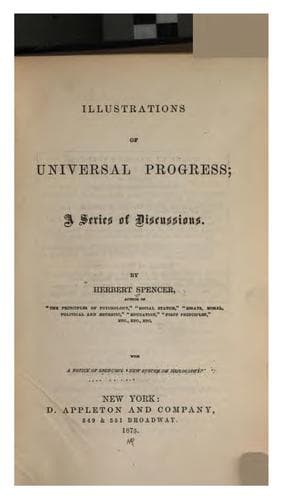
Illustrations of Universal Progress: A Series of DiscussionsSpencer, Herbert
Philosophy
Illustrations of Universal Progress: A Series of Discussions
Spencer, Herbert
Philosophy; Political science; Science
It must be admitted that the application of these methods is here by no
means so easy. Though we can note differences and similarities between the
internal formations of two animals; it is difficult to contrast the mental
states of two animals. Though the true morphological relations of organs
may be made out by the observations of embryos; yet, where such organs are
inactive before birth, we cannot completely trace the history of their
actions. Obviously, too, the pursuance of inquiries of the kind indicated,
raises questions which science is not yet prepared to answer; as, for
instance--Whether all nervous functions, in common with all other
functions, arise by gradual differentiations, as their organs do? Whether
the emotions are, therefore, to be regarded as divergent modes of action,
that have become unlike by successive modifications? Whether, as two organs
which originally budded out of the same membrane, have not only become
different as they developed, but have also severally become compound
internally, though externally simple: so two emotions, simple and near akin
in their roots, may not only have grown unlike, but may also have grown
involved in their natures, though seeming homogeneous to consciousness. And
here, indeed, in the inability of existing science to answer these
questions which underlie a true psychological classification, we see how
purely provisional any present classification is likely to be.
Nevertheless, even now, classification may be aided by development and
ultimate analysis to a considerable extent; and the defect in Mr. Bain's
work is, that he has not systematically availed himself of them as far as
possible. Thus we may, in the first place, study the evolution of the
emotions up through the various grades of the animal kingdom: observing
which of them are earliest and exist with the lowest organization and
intelligence; in what order the others accompany higher endowments; and how
they are severally related to the conditions of life. In the second place,
we may note the emotional differences between the lower and the higher
human races--may regard as earlier and simpler those feelings which are
common to both, and as later and more compound those which are
characteristic of the most civilized. In the third place, we may observe
the order in which the emotions unfold during the progress from infancy to
maturity. And lastly, comparing these three kinds of emotional development,
displayed in the ascending grades of the animal kingdom, in the advance of
the civilized races, and in individual history, we may see in what respects
they harmonize, and what are the implied general truths.
Public-domain text, read in full here on John Shaqi.
Reviews
Reviews
No reviews yet
Be the first to share your thoughts on this work.
Elsewhere in the archive
Join the Discussion
Join the discussion
Sign in to leave a comment or review.
Sign InorCreate an account