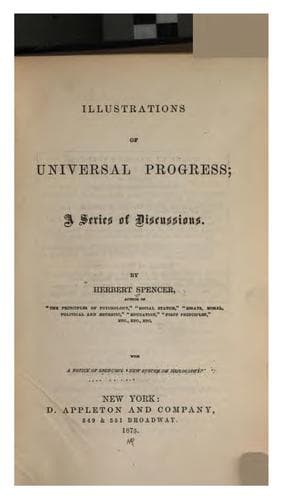
Illustrations of Universal Progress: A Series of DiscussionsSpencer, Herbert
Philosophy
Illustrations of Universal Progress: A Series of Discussions
Spencer, Herbert
Philosophy; Political science; Science
Having gathered together and generalized these several classes of facts,
analysis of the emotions would be made easier. Setting out with the
unquestionable assumption, that every new form of emotion making its
appearance in the individual or the race, is a modification of some
pre-existing emotion, or a compounding of several pre-existing emotions; we
should be greatly aided by knowing what always are the pre-existing
emotions. When, for example, we find that very few if any of the lower
animals show any love of accumulation, and that this feeling is absent in
infancy--when we see that an infant in arms exhibits anger, fear, wonder,
while yet it manifests no desire of permanent possession, and that a brute
which has no acquisitive emotion can nevertheless feel attachment,
jealousy, love of approbation; we may suspect that the feeling which
property satisfies, is compounded out of simpler and deeper feelings. We
may conclude that as, when a dog hides a bone, there must exist in him a
prospective gratification of hunger; so there must similarly at first, in
all cases where anything is secured or taken possession of, exist an ideal
excitement of the feeling which that thing will gratify. We may further
conclude that when the intelligence is such that a variety of objects come
to be utilized for different purposes--when, as among savages, divers wants
are satisfied through the articles appropriated for weapons, shelter,
clothing, ornament; the act of appropriating comes to be one constantly
involving agreeable associations, and one which is therefore pleasurable,
irrespective of the end subserved. And when, as in civilized life, the
property acquired is of a kind not conducing to one order of
gratifications, but is capable of administering to all gratifications, the
pleasure of acquiring property grows more distinct from each of the various
pleasures subserved--is more completely differentiated into a separate
emotion.
This illustration, roughly as it is sketched, will show what we mean by the
use of comparative psychology in aid of classification. Ascertaining by
induction the actual order of evolution of the emotions, we are led to
suspect this to be their order of successive dependence; and are so led to
recognize their order of ascending complexity; and by consequence their
true groupings.
Public-domain text, read in full here on John Shaqi.
Reviews
Reviews
No reviews yet
Be the first to share your thoughts on this work.
Elsewhere in the archive
Join the Discussion
Join the discussion
Sign in to leave a comment or review.
Sign InorCreate an account