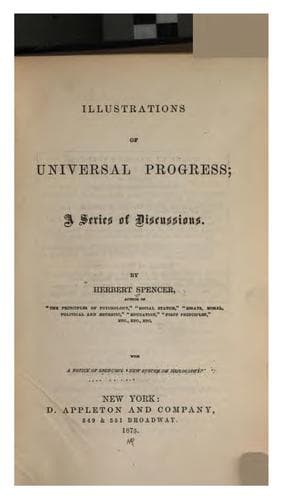
Illustrations of Universal Progress: A Series of DiscussionsSpencer, Herbert
Philosophy
Illustrations of Universal Progress: A Series of Discussions
Spencer, Herbert
Philosophy; Political science; Science
When, in the circumstances of any race, some one kind of action or set of
actions, sensation or set of sensations, is usually followed, or
accompanied by, various other sets of actions or sensations, and so entails
a large mass of pleasurable or painful states of consciousness; these, by
frequent repetition, become so connected together that the initial action
or sensation brings the ideas of all the rest crowding into consciousness:
producing, in a degree, the pleasures or pains that have before been felt
in reality. And when this relation, besides being frequently repeated in
the individual, occurs in successive generations, all the many nervous
actions involved tend to grow organically connected. They become
incipiently reflex; and on the occurrence of the appropriate stimulus, the
whole nervous apparatus which in past generations was brought into activity
by this stimulus, becomes nascently excited. Even while yet there have been
no individual experiences, a vague feeling of pleasure or pain is produced;
constituting what we may call the body of the emotion. And when the
experiences of past generations come to be repeated in the individual, the
emotion gains both strength and definiteness; and is accompanied by the
appropriate specific ideas.
This view of the matter, which we believe the established truths of
Physiology and Psychology unite in indicating, and which is the view that
generalizes the phenomena of habit, of national characteristics, of
civilization in its moral aspects, at the same time that it gives us a
conception of emotion in its origin and ultimate nature, may be illustrated
from the mental modifications undergone by animals.
Public-domain text, read in full here on John Shaqi.
Reviews
Reviews
No reviews yet
Be the first to share your thoughts on this work.
Elsewhere in the archive
Join the Discussion
Join the discussion
Sign in to leave a comment or review.
Sign InorCreate an account