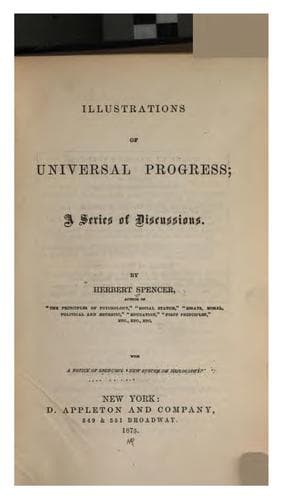
Illustrations of Universal Progress: A Series of DiscussionsSpencer, Herbert
Philosophy
Illustrations of Universal Progress: A Series of Discussions
Spencer, Herbert
Philosophy; Political science; Science
It is well-known that on newly-discovered lands not inhabited by man, birds
are so devoid of fear as to allow themselves to be knocked over with
sticks; but that in the course of generations, they acquire such a dread of
man as to fly on his approach; and that this dread is manifested by young
as well as old. Now unless this change be ascribed to the killing-off of
the least fearful, and the preservation and multiplication of the more
fearful, which, considering the comparatively small number killed by man,
is an inadequate cause; it must be ascribed to accumulated experiences; and
each experience must be held to have a share in producing it. We must
conclude that in each bird that escapes with injuries inflicted by man, or
is alarmed by the outcries of other members of the flock (gregarious
creatures of any intelligence being necessarily more or less sympathetic),
there is established an association of ideas between the human aspect and
the pains, direct and indirect, suffered from human agency. And we must
further conclude, that the state of consciousness which impels the bird to
take flight, is at first nothing more than an ideal reproduction of those
painful impressions which before followed man's approach; that such ideal
reproduction becomes more vivid and more massive as the painful
experiences, direct or sympathetic, increase; and that thus the emotion in
its incipient state, is nothing else than an aggregation of the revived
pains before experienced.
As, in the course of generations, the young birds of this race begin to
display a fear of man before yet they have been injured by him; it is an
unavoidable inference that the nervous system of the race has been
organically modified by these experiences: we have no choice but to
conclude that when a young bird is thus led to fly, it is because the
impression produced on its senses by the approaching man, entails, through
an incipiently-reflex action, a partial excitement of all those nerves
which in its ancestors had been excited under the like conditions; that
this partial excitement has its accompanying painful consciousness; and
that the vague painful consciousness thus arising, constitutes emotion
proper--_emotion undecomposable into specific experiences, and therefore
seemingly homogeneous_.
If such be the explanation of the fact in this case, then it is in all
cases. If emotion is so generated here, then it is so generated throughout.
We must perforce conclude that the emotional modifications displayed by
different nations, and those higher emotions by which civilized are
distinguished from savage, are to be accounted for on the same principle.
And concluding this, we are led strongly to suspect that the emotions in
general have severally thus originated.
Public-domain text, read in full here on John Shaqi.
Reviews
Reviews
No reviews yet
Be the first to share your thoughts on this work.
Elsewhere in the archive
Join the Discussion
Join the discussion
Sign in to leave a comment or review.
Sign InorCreate an account