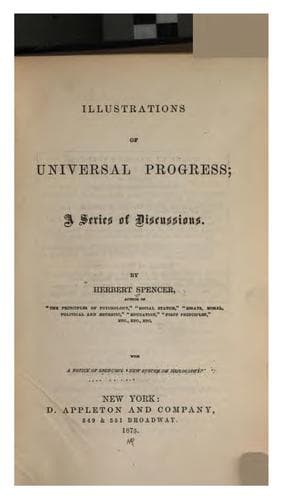
Illustrations of Universal Progress: A Series of DiscussionsSpencer, Herbert
Philosophy
Illustrations of Universal Progress: A Series of Discussions
Spencer, Herbert
Philosophy; Political science; Science
Perhaps we have now made sufficiently clear what we mean by the study of
the emotions through analysis and development. We have aimed to justify the
positions that, without analysis aided by development, there cannot be a
true natural history of the emotions; and that a natural history of the
emotions based on external characters, can be but provisional. We think
that Mr. Bain, in confining himself to an account of the emotions as they
exist in the adult civilized man, has neglected those classes of facts out
of which the science of the matter must chiefly be built. It is true that
he has treated of habits as modifying emotions in the individual; but he
has not recognized the fact, that where conditions render habits persistent
in successive generations, such modifications are cumulative: he has not
hinted that the modifications produced by habit are emotions in the making.
It is true, also, that he occasionally refers to the characteristics of
children; but he does not systematically trace the changes through which
childhood passes into manhood, as throwing light on the order and genesis
of the emotions. It is further true that he here and there refers to
national traits in illustration of his subject; but these stand as isolated
facts, having no general significance: there is no hint of any relation
between them and the national circumstances; while all those many moral
contrasts between lower and higher races which throw great light on
classification, are passed over. And once more, it is true that many
passages of his work, and sometimes, indeed, whole sections of it, are
analytical; but his analyses are incidental--they do not underlie his
entire scheme, but are here and there added to it. In brief, he has written
a Descriptive Psychology, which does not appeal to Comparative Psychology
and Analytical Psychology for its leading ideas. And in doing this, he has
omitted much that should be included in a natural history of the mind;
while to that part of the subject with which he has dealt, he has given a
necessarily-imperfect organization.
* * * * *
Even leaving out of view the absence of those methods and criteria on which
we have been insisting, it appears to us that meritorious as is Mr. Bain's
book in its details, it is defective in some of its leading ideas. The
first paragraphs of his first chapter, quite startled us by the strangeness
of their definitions--a strangeness which can scarcely be ascribed to
laxity of expression. The paragraphs run thus:--
"Mind is comprised under three heads--Emotion, Volition, and
Intellect.
"EMOTION is the name here used to comprehend all that is understood
by feelings, states of feeling, pleasures, pains, passions,
sentiments, affections. Consciousness, and conscious states also for
the most part denote modes of emotion, although there is such a thing
as the Intellectual consciousness.
Public-domain text, read in full here on John Shaqi.
Reviews
Reviews
No reviews yet
Be the first to share your thoughts on this work.
Elsewhere in the archive
Join the Discussion
Join the discussion
Sign in to leave a comment or review.
Sign InorCreate an account