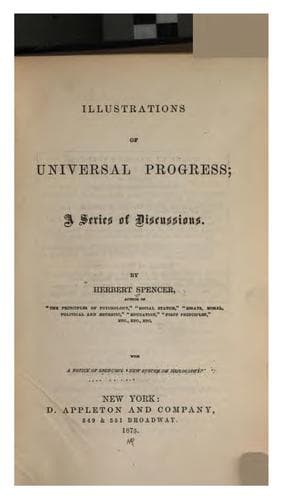
Illustrations of Universal Progress: A Series of DiscussionsSpencer, Herbert
Philosophy
Illustrations of Universal Progress: A Series of Discussions
Spencer, Herbert
Philosophy; Political science; Science
A parallel criticism applies to his definition of Emotion. Here, too, he
has departed from the ordinary acceptation of the word; and, as we think,
in the wrong direction. Whatever may be the interpretation that is
justified by its derivation, the word Emotion has come generally to mean
that kind of feeling which is not a direct result of any action on the
organism; but is either an indirect result of such action, or arises quite
apart from such action. It is used to indicate those sentient states which
are independently generated in consciousness; as distinguished from those
generated in our corporeal framework, and known as sensations. Now this
distinction, tacitly made in common speech, is one which Psychology cannot
well reject; but one which it must adopt, and to which it must give
scientific precision. Mr. Bain, however, appears to ignore any such
distinction. Under the term "emotion," he includes not only passions,
sentiments, affections, but all "feelings, states of feeling, pleasures,
pains,"--that is, all sensations. This does not appear to be a mere lapse
of expression; for when, in the opening sentence, he asserts that "mind is
comprised under the three heads--Emotion, Volition, and Intellect," he of
necessity implies that sensation is included under one of these heads; and
as it cannot be included under Volition or Intellect, it must be classed
with Emotion: as it clearly is in the next sentence.
We cannot but think this is a retrograde step. Though distinctions which
have been established in popular thought and language, are not unfrequently
merged in the higher generalizations of science (as, for instance, when
crabs and worms are grouped together in the sub-kingdom _Annulosa_;) yet
science very generally recognizes the validity of these distinctions, as
real though not fundamental. And so in the present case. Such community as
analysis discloses between sensation and emotion, must not shut out the
broad contrast that exists between them. If there needs a wider word, as
there does, to signify any sentient state whatever; then we may fitly adopt
for this purpose the word currently so used, namely, "Feeling." And
considering as Feelings all that great division of mental states which we
do not class as Cognitions, may then separate this great division into the
two orders, Sensations and Emotions.
* * * * *
And here we may, before concluding, briefly indicate the leading outlines
of a classification which reduces this distinction to a scientific form,
and developes it somewhat further--a classification which, while suggested
by certain fundamental traits reached without a very lengthened inquiry, is
yet, we believe, in harmony with that disclosed by detailed analysis.
Public-domain text, read in full here on John Shaqi.
Reviews
Reviews
No reviews yet
Be the first to share your thoughts on this work.
Elsewhere in the archive
Join the Discussion
Join the discussion
Sign in to leave a comment or review.
Sign InorCreate an account