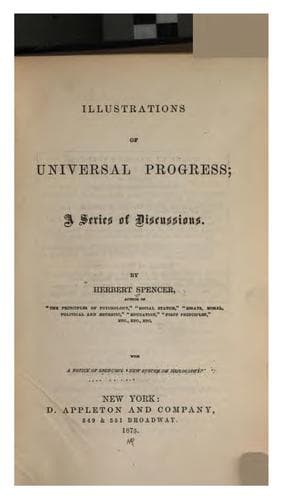
Illustrations of Universal Progress: A Series of DiscussionsSpencer, Herbert
Philosophy
Illustrations of Universal Progress: A Series of Discussions
Spencer, Herbert
Philosophy; Political science; Science
Leaving out of view the Will, which is a simple homogeneous mental state,
forming the link between feeling and action, and not admitting of
subdivisions; our states of consciousness fall into two great
classes--COGNITIONS and FEELINGS.
COGNITIONS, or those modes of mind in which we are occupied with the
_relations_ that subsist among our feelings, are divisible into four great
sub-classes.
_Presentative cognitions_; or those in which consciousness is occupied in
localizing a sensation impressed on the organism--occupied, that is, with
the relation between this presented mental state and those other presented
mental states which make up our consciousness of the part affected: as when
we cut ourselves.
_Presentative-representative cognitions_; or those in which consciousness
is occupied with the relation between a sensation or group of sensations
and the representations of those various other sensations that accompany it
in experience. This is what we commonly call perception--an act in which,
along with certain impressions presented to consciousness, there arise in
consciousness the ideas of certain other impressions ordinarily connected
with the presented ones: as when its visible form and colour, lead us to
mentally endow an orange with all its other attributes.
_Representative cognitions_; or those in which consciousness is occupied
with the relations among ideas or represented sensations: as in all acts of
recollection.
_Re-representative cognitions_; or those in which the occupation of
consciousness is not by representation of special relations, that have
before been presented to consciousness; but those in which such represented
special relations are thought of merely as comprehended in a general
relation--those in which the concrete relations once experienced, in so far
as they become objects of consciousness at all, are incidentally
represented, along with the abstract relation which formulates them. The
ideas resulting from this abstraction, do not themselves represent actual
experiences; but are symbols which stand for groups of such actual
experiences--represent aggregates of representations. And thus they may be
called re-representative cognitions. It is clear that the process of
re-representation is carried to higher stages, as the thought becomes more
abstract.
FEELINGS, or those modes of mind in which we are occupied, not with the
relations subsisting between our sentient states, but with the sentient
states themselves, are divisible into four parallel sub-classes.
_Presentative feelings_, ordinarily called sensations, are those mental
states in which, instead of regarding a corporeal impression as of this or
that kind, or as located here or there, we contemplate it in itself as
pleasure or pain: as when eating.
Public-domain text, read in full here on John Shaqi.
Reviews
Reviews
No reviews yet
Be the first to share your thoughts on this work.
Elsewhere in the archive
Join the Discussion
Join the discussion
Sign in to leave a comment or review.
Sign InorCreate an account