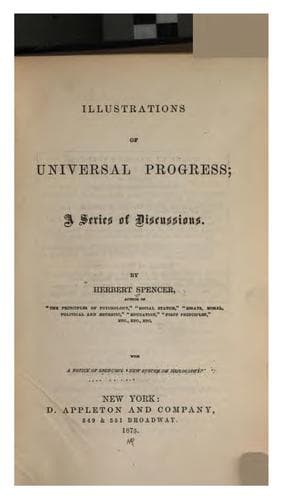
Illustrations of Universal Progress: A Series of DiscussionsSpencer, Herbert
Philosophy
Illustrations of Universal Progress: A Series of Discussions
Spencer, Herbert
Philosophy; Political science; Science
_Presentative-representative feelings_, embracing a great part of what we
commonly call emotions, are those in which a sensation, or group of
sensations or group of sensations and ideas, arouses a vast aggregation of
represented sensations; partly of individual experience, but chiefly deeper
than individual experience, and, consequently, indefinite. The emotion of
terror may serve as an example. Along with certain impressions made on the
eyes or ears, or both, are recalled in consciousness many of the pains to
which such impressions have before been the antecedents; and when the
relation between such impressions and such pains has been habitual in the
race, the definite ideas of such pains which individual experience has
given, are accompanied by the indefinite pains that result from inherited
experience--vague feelings which we may call organic representations. In an
infant, crying at a strange sight or sound while yet in the nurse's arms,
we see these organic representations called into existence in the shape of
dim discomfort, to which individual experience has yet given no specific
outlines.
_Representative feelings_, comprehending the ideas of the feelings above
classed, when they are called up apart from the appropriate external
excitements. As instances of these may be named the feelings with which the
descriptive poet writes, and which are aroused in the minds of his readers.
_Re-representative feelings_, under which head are included those more
complex sentient states that are less the direct results of external
excitements than the indirect or reflex results of them. The love of
property is a feeling of this kind. It is awakened not by the presence of
any special object, but by ownable objects at large; and it is not from the
mere presence of such object, but from a certain ideal relation to them,
that it arises. As before shown (p. 311) it consists, not of the
represented advantages of possessing this or that, but of the represented
advantages of possession in general--is not made up of certain concrete
representations, but of the abstracts of many concrete representations; and
so is re-representative. The higher sentiments, as that of justice, are
still more completely of this nature. Here the sentient state is compounded
out of sentient states that are themselves wholly, or almost wholly,
re-representative: it involves representations of those lower emotions
which are produced by the possession of property, by freedom of action,
etc.; and thus is re-representative in a higher degree.
Public-domain text, read in full here on John Shaqi.
Reviews
Reviews
No reviews yet
Be the first to share your thoughts on this work.
Elsewhere in the archive
Join the Discussion
Join the discussion
Sign in to leave a comment or review.
Sign InorCreate an account