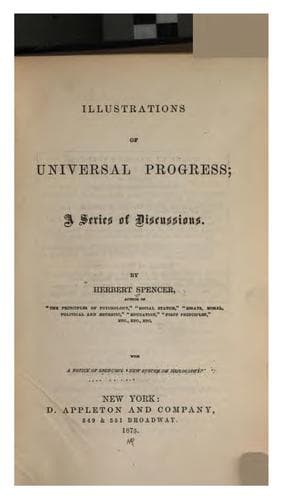
Illustrations of Universal Progress: A Series of DiscussionsSpencer, Herbert
Philosophy
Illustrations of Universal Progress: A Series of Discussions
Spencer, Herbert
Philosophy; Political science; Science
On this unity of mineral character it is, that this Scottish formation is
concluded to be contemporaneous with the lowest formations in Wales; for
the scanty palaeontological evidence suffices neither for proof nor
disproof. Now, had there been a continuity of like strata in like order
between Wales and Scotland, there might have been little to criticise in
this conclusion. But since Sir R. Murchison himself admits, that in
Westmoreland and Cumberland, some members of the system "assume a
lithological aspect different from what they maintain in the Silurian and
Welsh region," there seems no reason to expect mineralogical continuity in
Scotland. Obviously therefore, the assumption that these Scottish
formations are of the same age with the Longmynd of Shropshire, implies the
latent belief that certain mineral characters indicate certain eras.
Far more striking instances, however, of the influence of this latent
belief remain to be given. Not in such comparatively near districts as the
Scottish lowlands only, does Sir R. Murchison expect a repetition of the
Longmynd strata; but in the Rhenish provinces, certain "quartzose
flagstones and grits, like those of the Longmynd," are seemingly concluded
to be of contemporaneous origin, because of their likeness. "Quartzites in
roofing-slates with a greenish tinge that reminded us of the lower slates
of Cumberland and Westmoreland," are evidently suspected to be of the same
age. In Russia, he remarks that the carboniferous limestones "are overlaid
along the western edge of the Ural chain by sandstones and grits, which
occupy much the same place in the general series as the millstone grit of
England;" and in calling this group, as he does, the "representative of the
millstone grit," Sir R. Murchison clearly shows that he thinks likeness of
mineral composition some evidence of equivalence in time, even at that
great distance. Nay, on the flanks of the Andes and in the United States,
such similarities are looked for, and considered as significant of certain
ages. Not that Sir R. Murchison contends theoretically for this relation
between lithological character and date. For on the page from which we have
just quoted (_Siluria_, p. 387), he says, that "whilst the soft Lower
Silurian clays and sands of St. Petersburg have their equivalents in the
hard schists and quartz rocks with gold veins in the heart of the Ural
mountains, the equally soft red and green Devonian marls of the Valdai
Hills are represented on the western flank of that chain, by hard,
contorted, and fractured limestones." But these, and other such admissions,
seem to go for little. Whilst himself asserting that the Potsdam-sandstone
of North America, the Lingula-flags of England, and the alum-slates of
Scandinavia are of the same period--while fully aware that among the
Silurian formations of Wales, there are oolitic strata like those of
secondary age; yet is his reasoning more or less coloured by the
Public-domain text, read in full here on John Shaqi.
Reviews
Reviews
No reviews yet
Be the first to share your thoughts on this work.
Elsewhere in the archive
Join the Discussion
Join the discussion
Sign in to leave a comment or review.
Sign InorCreate an account