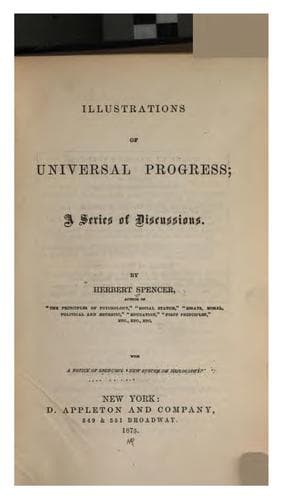
Illustrations of Universal Progress: A Series of DiscussionsSpencer, Herbert
Philosophy
Illustrations of Universal Progress: A Series of Discussions
Spencer, Herbert
Philosophy; Political science; Science
assumption, that formations of like qualities probably belong to the same
era. Is it not manifest, then, that the exploded hypothesis of Werner
continues to influence geological speculation?
"But," it will perhaps be said, "though individual strata are not
continuous over large areas, yet systems of strata are. Though within a few
miles the same bed gradually passes from clay into sand, or thins out and
disappears, yet the group of strata to which it belongs does not do so; but
maintains in remote regions the same relations to other groups."
This is the generally-current belief. On this assumption the received
geological classifications appear to be framed. The Silurian system, the
Devonian system, the Carboniferous system, etc., are set down in our books
as groups of formations which everywhere succeed each other in a given
order; and are severally everywhere of the same age. Though it may not be
asserted that these successive systems are universal; yet it seems to be
tacitly assumed that they are so. In North and South America, in Asia, in
Australia, sets of strata are assimilated to one or other of these groups;
and their possession of certain mineral characters and a certain order of
superposition are among the reasons assigned for so assimilating them.
Though, probably, no competent geologist would contend that the European
classification of strata is applicable to the globe as a whole; yet most,
if not all geologists, write as though it were so. Among readers of works
on Geology, nine out of ten carry away the impression that the divisions,
Primary, Secondary and Tertiary, are of absolute and uniform application;
that these great divisions are separable into subdivisions, each of which
is definitely distinguishable from the rest, and is everywhere recognizable
by its characters as such or such; and that in all parts of the Earth,
these minor systems severally began and ended at the same time. When they
meet with the term "carboniferous era," they take for granted that it was
an era universally carboniferous--that it was, what Hugh Miller indeed
actually describes it, an era when the Earth bore a vegetation far more
luxuriant than it has since done; and were they in any of our colonies to
meet with a coal-bed, they would conclude that, as a matter of course, it
was of the same age as the English coal-beds.
Public-domain text, read in full here on John Shaqi.
Reviews
Reviews
No reviews yet
Be the first to share your thoughts on this work.
Elsewhere in the archive
Join the Discussion
Join the discussion
Sign in to leave a comment or review.
Sign InorCreate an account