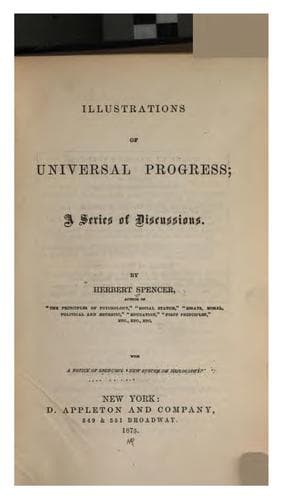
Illustrations of Universal Progress: A Series of DiscussionsSpencer, Herbert
Philosophy
Illustrations of Universal Progress: A Series of Discussions
Spencer, Herbert
Philosophy; Political science; Science
Nevertheless, while in this and numerous passages of like implication, Sir
C. Lyell protests against the bias here illustrated, he seems himself not
completely free from it. Though he utterly rejects the old hypothesis that
all over the Earth the same continuous strata lie upon each other in
regular order, like the coats of an onion, he still writes as though
geologic "systems" do thus succeed each other. A reader of his _Manual_
would certainly suppose him to believe, that the Primary epoch ended, and
the Secondary epoch commenced, all over the world at the same time--that
these terms really correspond to distinct universal eras in Nature. When he
assumes, as he does, that the division between Cambrian and Lower Silurian
in America, answers chronologically to the division between Cambrian and
Lower Silurian in Wales--when he takes for granted that the partings of
Lower from Middle Silurian, and of Middle Silurian from Upper, in the one
region, are of the same dates as the like partings in the other region;
does it not seem that he believes geologic "systems" to be universal, in
the sense that their separations were in all places contemporaneous? Though
he would, doubtless, disown this as an article of faith, is not his
thinking unconsciously influenced by it? Must we not say that though the
onion-coat hypothesis is dead, its spirit is traceable, under a
transcendental form, even in the conclusions of its antagonists?
* * * * *
Let us now consider another leading geological doctrine, introduced to us
by the cases just mentioned. We mean the doctrine that strata of the same
age contain like fossils; and that, therefore, the age and relative
position of any stratum may be known by its fossils. While the theory that
strata of like mineral characters were everywhere deposited simultaneously,
has been ostensibly abandoned, there has been accepted the theory that in
each geologic epoch similar plants and animals existed everywhere; and
that, therefore, the epoch to which any formation belongs may be known by
the organic remains contained in the formation. Though, perhaps, no leading
geologist would openly commit himself to an unqualified assertion of this
theory, yet it is tacitly assumed in current geological reasoning.
Public-domain text, read in full here on John Shaqi.
Reviews
Reviews
No reviews yet
Be the first to share your thoughts on this work.
Elsewhere in the archive
Join the Discussion
Join the discussion
Sign in to leave a comment or review.
Sign InorCreate an account