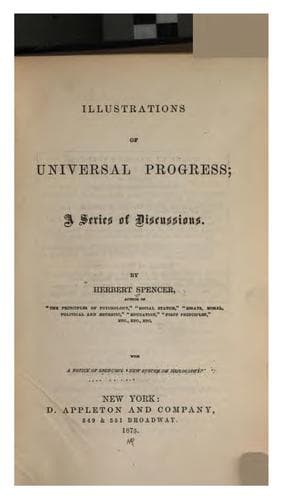
Illustrations of Universal Progress: A Series of DiscussionsSpencer, Herbert
Philosophy
Illustrations of Universal Progress: A Series of Discussions
Spencer, Herbert
Philosophy; Political science; Science
This theory, however, is scarcely more tenable than the other. It cannot be
concluded with any certainty, that formations in which similar organic
remains are found, were of contemporaneous origin; nor can it be safely
concluded that strata containing different organic remains are of different
ages. To most readers these will be startling propositions; but they are
fully admitted by the highest authorities. Sir Charles Lyell confesses that
the test of organic remains must be used "under very much the same
restrictions as the test of mineral composition." Sir Henry de la Beche,
who variously illustrates this truth, gives, as one instance, the great
incongruity there must be between the fossils of our carboniferous rocks
and those of the marine strata deposited at the same period. But though, in
the abstract, the danger of basing positive conclusions on evidence derived
from fossils, is clearly recognized; yet, in the concrete, this danger is
generally disregarded. The established conclusions respecting the ages of
strata, take but little note of it; and by some geologists it seems
altogether ignored. Throughout his _Siluria_, Sir R. Murchison habitually
assumes that the same, or kindred, species, lived in all parts of the Earth
at the same time. In Russia, in Bohemia, in the United States, in South
America, strata are classed as belonging to this or that part of the
Silurian system, because of the similar fossils contained in them--are
concluded to be everywhere contemporaneous if they enclose a proportion of
identical or allied forms. In Russia the relative position of a stratum is
inferred from the fact that, along with some Wenlock forms, it yields the
_Pentamerus oblongus_. Certain crustaceans called Eurypteri, being
characteristic of the Upper Ludlow rock, it is remarked that "large
Eurypteri occur in a so-called black grey-wacke slate in Westmoreland, in
Oneida County, New York, which will probably be found to be on the parallel
of the Upper Ludlow rock:" in which word "probably," we see both how
dominant is this belief of universal distribution of similar creatures at
the same period, and how apt this belief is to make its own proof, by
raising the expectation that the ages are identical when the forms are
alike. Besides thus interpreting the formations of Russia, England, and
America, Sir R. Murchison thus interprets those of the antipodes. Fossils
from Victoria Colony, he agrees with the Government-surveyor in classing as
of Lower Silurian or Llandovery age: that is, he takes for granted that
when certain crustaceans and mollusks were living in Wales, certain similar
crustaceans and mollusks were living in Australia.
Public-domain text, read in full here on John Shaqi.
Reviews
Reviews
No reviews yet
Be the first to share your thoughts on this work.
Elsewhere in the archive
Join the Discussion
Join the discussion
Sign in to leave a comment or review.
Sign InorCreate an account