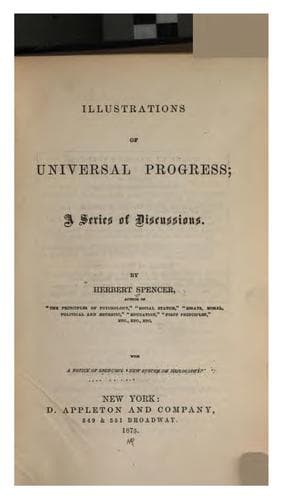
Illustrations of Universal Progress: A Series of DiscussionsSpencer, Herbert
Philosophy
Illustrations of Universal Progress: A Series of Discussions
Spencer, Herbert
Philosophy; Political science; Science
Thus the reasoning from which it is concluded that similar organic forms
were once more widely spread, is doubly fallacious; and, consequently, the
classifications of foreign strata based on this conclusion are
untrustworthy. Judging from the present distribution of life, we can
scarcely expect to find similar remains in geographically remote strata of
the same age; and where, between the fossils of geographically remote
strata, we do find much similarity, it is probably often due rather to
likeness of conditions than to contemporaneity. If from causes and effects
such as we now witness, we reason back to the causes and effects of past
epochs, we discover inadequate warrant for sundry of the received
doctrines. Seeing, as we do, that in large areas of the Pacific this is a
period characterized by abundance of corals; that in the North Atlantic it
is a period in which a great chalk-deposit is being formed; and that in the
valley of the Mississippi it is a period of new coal-basins--seeing also,
as we do, that in one extensive continent this is peculiarly an era of
implacental mammals, and that in another extensive continent it is
peculiarly an era of placental mammals; we have good reason to hesitate
before accepting these sweeping generalizations which are based on a
cursory examination of strata occupying but a tenth part of the Earth's
surface.
* * * * *
At the outset, this article was to have been a review of the works of Hugh
Miller; but it has grown into something much more general. Nevertheless,
the remaining two doctrines which we propose to criticise, may be
conveniently treated in connection with his name, as that of one who fully
committed himself to them. And first, a few words with regard to his
position.
That he was a man whose life was one of meritorious achievement, every one
knows. That he was a diligent and successful working geologist, scarcely
needs saying. That with indomitable perseverance he struggled up from
obscurity to a place in the world of literature and science, shows him to
have been highly endowed in character and intelligence. And that he had a
remarkable power of presenting his facts and arguments in an attractive
form, a glance at any of his books will quickly prove. By all means, let us
respect him as a man of activity and sagacity, joined with a large amount
of poetry. But while saying this we must add, that his reputation stands by
no means so high in the scientific world as in the world at large. Partly
from the fact that our Scotch neighbours are in the habit of blowing the
trumpet rather loudly before their notabilities--partly because the
charming style in which his books are written has gained him a large circle
of readers--partly, perhaps, through a praiseworthy sympathy with him as a
self-made man; Hugh Miller has met with an amount of applause which, little
as we wish to diminish it, must not be allowed to blind the public to his
defects as a man of science.
Public-domain text, read in full here on John Shaqi.
Reviews
Reviews
No reviews yet
Be the first to share your thoughts on this work.
Elsewhere in the archive
Join the Discussion
Join the discussion
Sign in to leave a comment or review.
Sign InorCreate an account