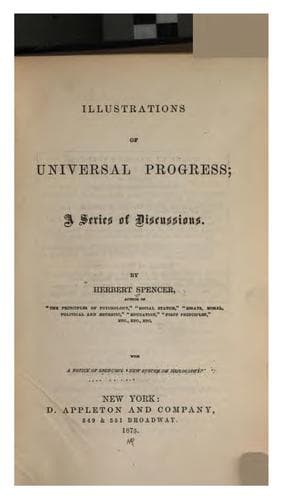
Illustrations of Universal Progress: A Series of DiscussionsSpencer, Herbert
Philosophy
Illustrations of Universal Progress: A Series of Discussions
Spencer, Herbert
Philosophy; Political science; Science
The truth is, he was so far committed to a foregone conclusion, that he
could not become a philosophical geologist. He might be aptly described as
a theologian studying geology. The dominant idea with which he wrote, may
be seen in the titles of his books--_Law versus Miracle_,--_Footprints of
the Creator_,--_The Testimony of the Rocks_. Regarding geological facts as
evidence for or against certain religious conclusions, it was scarcely
possible for him to deal with geological facts impartially. His ruling aim
was to disprove the Development Hypothesis, the assumed implications of
which were repugnant to him; and in proportion to the strength of his
feeling, was the one-sidedness of his reasoning. He admitted that "God
might as certainly have _originated_ the species by a law of development,
as he _maintains_ it by a law of development; the existence of a First
Great Cause is as perfectly compatible with the one scheme as with the
other." Nevertheless, he considered the hypothesis at variance with
Christianity; and therefore combated with it. He apparently overlooked the
fact that the doctrines of geology in general, as held by himself, had been
rejected by many on similar grounds; and that he had himself been
repeatedly attacked for his anti-Christian teachings. He seems not to have
perceived that, just as his antagonists were wrong in condemning as
irreligious, theories which he saw were not irreligious; so might he be
wrong in condemning, on like grounds, the Theory of Evolution. In brief, he
fell short of that highest faith, which knows that all truths must
harmonize; and which is, therefore, content trustfully to follow the
evidence whithersoever it leads.
Of course it is impossible to criticize his works without entering on this
great question to which he chiefly devoted himself. The two remaining
doctrines to be here discussed, bear directly on this question; and, as
above said, we propose to treat them in connection with Hugh Miller's name,
because, throughout his reasonings, he assumes their truth. Let it not be
supposed, however, that we shall aim to prove what he has aimed to
disprove. While we purpose showing that his arguments against the
Development Hypothesis are based on invalid assumptions; we do not purpose
showing that the opposing arguments are based on valid assumptions. We hope
to make it apparent that the geological evidence at present obtained, is
insufficient for either side; further, that there seems little probability
of sufficient evidence ever being obtained; and that if the question is
eventually decided, it must be decided on other than geological data.
* * * * *
Public-domain text, read in full here on John Shaqi.
Reviews
Reviews
No reviews yet
Be the first to share your thoughts on this work.
Elsewhere in the archive
Join the Discussion
Join the discussion
Sign in to leave a comment or review.
Sign InorCreate an account