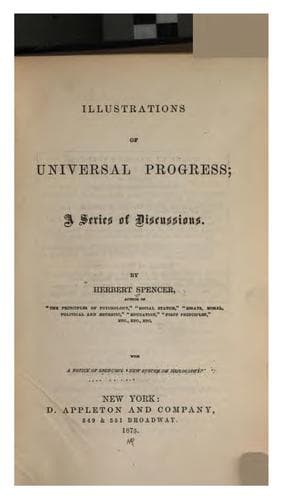
Illustrations of Universal Progress: A Series of DiscussionsSpencer, Herbert
Philosophy
Illustrations of Universal Progress: A Series of Discussions
Spencer, Herbert
Philosophy; Political science; Science
Now, if these minor revolutions of the Earth's surface produce minor breaks
in the series of fossilized remains; must not great revolutions produce
great breaks? If a local upheaval or subsidence causes throughout its small
area the absence of some links in the chain of fossil forms; does it not
follow that an upheaval or subsidence extending over a large part of the
Earth's surface, must cause the absence of a great number of such links
throughout a very wide area?
When during a long epoch a continent, slowly subsiding, gives place to a
far-spreading ocean some miles in depth, at the bottom of which no deposits
from rivers or abraded shores can be thrown down; and when, after some
enormous period, this ocean-bottom is gradually elevated and becomes the
site of new strata; it is clear that the fossils contained in these new
strata are likely to have but little in common with the fossils of the
strata below them. Take, in illustration, the case of the North Atlantic.
We have already named the fact that between this country and the United
States, the ocean-bottom is being covered with a deposit of chalk--a
deposit that has been forming, probably, ever since there occurred that
great depression of the Earth's crust from which the Atlantic resulted in
remote geologic times. This chalk consists of the minute shells of
Foraminifera, sprinkled with remains of small Entomostraca, and probably a
few Pteropod-shells: though the sounding lines have not yet brought up any
of these last. Thus, in so far as all high forms of life are concerned,
this new chalk-formation must be a blank. At rare intervals, perhaps, a
polar bear drifted on an iceberg, may have its bones scattered over the
bed; or a dead, decaying whale may similarly leave traces. But such remains
must be so rare, that this new chalk-formation, if visible, might be
examined for a century before any of them were disclosed. If now, some
millions of years hence, the Atlantic-bed should be raised, and estuary or
shore deposits laid upon it, these deposits would contain remains of a
Flora and Fauna so distinct from everything below them, as to appear like a
new creation.
Thus, along with continuity of life on the Earth's surface, there not only
_may_ be, but there _must_ be, great gaps, in the series of fossils; and
hence these gaps are no evidence against the doctrine of Evolution.
* * * * *
One other current assumption remains to be criticized; and it is the one on
which, more than on any other, depends the view taken respecting the
question of development.
Public-domain text, read in full here on John Shaqi.
Reviews
Reviews
No reviews yet
Be the first to share your thoughts on this work.
Elsewhere in the archive
Join the Discussion
Join the discussion
Sign in to leave a comment or review.
Sign InorCreate an account