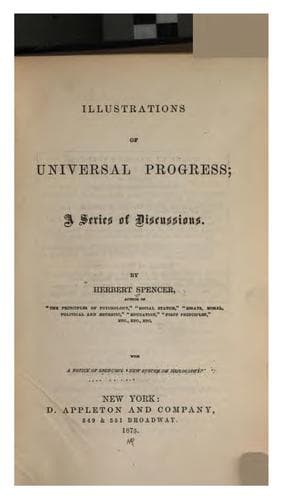
Illustrations of Universal Progress: A Series of DiscussionsSpencer, Herbert
Philosophy
Illustrations of Universal Progress: A Series of Discussions
Spencer, Herbert
Philosophy; Political science; Science
From the beginning of the controversy, the arguments for and against have
turned upon the evidence of progression in organic forms, found in the
ascending series of our sedimentary formations. On the one hand, those who
contend that higher organisms have been evolved out of lower, joined with
those who contend that successively higher organisms have been created at
successively later periods, appeal for proof to the facts of Palaeontology;
which, they say, countenance their views. On the other hand, the
Uniformitarians, who not only reject the hypothesis of development, but
deny that the modern forms of life are higher than the ancient ones, reply
that the Palaeontological evidence is at present very incomplete; that
though we have not yet found remains of highly-organized creatures in
strata of the greatest antiquity, we must not assume that no such creatures
existed when those strata were deposited; and that, probably, geological
research will eventually disclose them.
It must be admitted that thus far, the evidence has gone in favour of the
latter party. Geological discovery has year after year shown the small
value of negative facts. The conviction that there are no traces of higher
organisms in earlier strata, has resulted not from the absence of such
remains, but from incomplete examination. At p. 460 of his _Manual of
Elementary Geology_, Sir Charles Lyell gives a list in illustration of
this. It appears that in 1709, fishes were not known lower than the Permian
system. In 1793 they were found in the subjacent Carboniferous system; in
1828 in the Devonian; in 1840 in the Upper Silurian. Of reptiles, we read
that in 1710 the lowest known were in the Permian; in 1844 they were
detected in the Carboniferous; and in 1852 in the Upper Devonian. While of
the Mammalia the list shows that in 1798 none had been discovered below the
middle Eocene; but that in 1818 they were discovered in the Lower Oolite;
and in 1847 in the Upper Trias.
The fact is, however, that both parties set out with an inadmissible
postulate. Of the Uniformitarians, not only such writers as Hugh Miller,
but also such as Sir Charles Lyell,[T] reason as though we had found the
earliest, or something like the earliest, strata. Their antagonists,
whether defenders of the Development Hypothesis or simply Progressionists,
almost uniformly do the like. Sir R. Murchison, who is a Progressionist,
calls the lowest fossiliferous strata, "Protozoic." Prof. Ansted uses the
same term. Whether avowedly or not, all the disputants stand on this
assumption as their common ground.
[T] Sir Charles Lyell is no longer to be classed among
Uniformitarians. With rare and admirable candour he has, since
this was written, yielded to the arguments of Mr. Darwin.
Public-domain text, read in full here on John Shaqi.
Reviews
Reviews
No reviews yet
Be the first to share your thoughts on this work.
Elsewhere in the archive
Join the Discussion
Join the discussion
Sign in to leave a comment or review.
Sign InorCreate an account