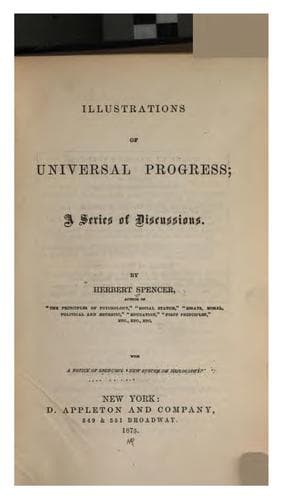
Illustrations of Universal Progress: A Series of DiscussionsSpencer, Herbert
Philosophy
Illustrations of Universal Progress: A Series of Discussions
Spencer, Herbert
Philosophy; Political science; Science
It is an established geological doctrine, that sedimentary strata are
liable to be changed, more or less completely, by igneous action. The rocks
originally classed as "transition," because they were intermediate in
character between the igneous rocks found below them, and the sedimentary
strata found above them, are now known to be nothing else than sedimentary
strata altered in texture and appearance by the intense heat of adjacent
molten matter; and hence are renamed "metamorphic rocks." Modern researches
have shown, too, that these metamorphic rocks are not, as was once
supposed, all of the same age. Besides primary and secondary strata that
have been transformed by igneous action, there are similarly-changed
deposits of tertiary origin; and that, even for a quarter of a mile from
the point of contact with neighbouring granite. By this process fossils are
of course destroyed. "In some cases," says Sir Charles Lyell, "dark
limestones, replete with shells and corals, have been turned into white
statuary marble, and hard clays, containing vegetable or other remains,
into slates called mica-schist or hornblende-schist; every vestige of the
organic bodies having been obliterated."
Again, it is fast becoming an acknowledged truth, that igneous rock, of
whatever kind, is the product of sedimentary strata that have been
completely melted. Granite and gneiss, which are of like chemical
composition, have been shown, in various cases, to pass one into the other:
as at Valorsine, near Mont Blanc, where the two, in contact, are observed
to "both undergo a modification of mineral character. The granite still
remaining unstratified, becomes charged with green particles; and the
talcose gneiss assumes a granitiform structure without losing its
stratification." In the Aberdeen-granite, lumps of unmelted gneiss are
frequently found; and we can ourselves bear witness that on the banks of
Loch Sunart, there is ample proof that the granite of that region, when it
was molten, contained incompletely-fused clots of sedimentary strata. Nor
is this all. Fifty years ago, it was thought that all granitic rocks were
primitive, or existed before any sedimentary strata; but it is now "no easy
task to point out a single mass of granite demonstrably more ancient than
all the known fossiliferous deposits."
Public-domain text, read in full here on John Shaqi.
Reviews
Reviews
No reviews yet
Be the first to share your thoughts on this work.
Elsewhere in the archive
Join the Discussion
Join the discussion
Sign in to leave a comment or review.
Sign InorCreate an account