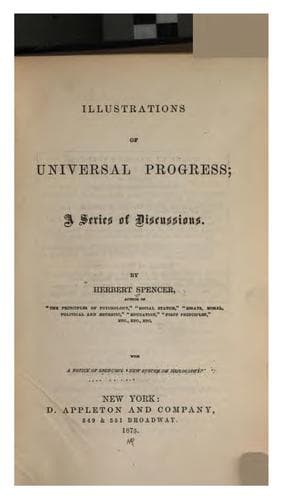
Illustrations of Universal Progress: A Series of DiscussionsSpencer, Herbert
Philosophy
Illustrations of Universal Progress: A Series of Discussions
Spencer, Herbert
Philosophy; Political science; Science
Yet is this assumption indefensible, as some who make it very well know.
Facts may be cited against it which show that it is a more than
questionable one--that it is a highly improbable one; while the evidence
assigned in its favour will not bear criticism.
Because in Bohemia, Great Britain, and portions of North America, the
lowest unmetamorphosed strata yet discovered, contain but slight traces of
life, Sir R. Murchison conceives that they were formed while yet few, if
any, plants or animals had been created; and, therefore, classes them as
"Azoic." His own pages, however, show the illegitimacy of the conclusion
that there existed at that period no considerable amount of life. Such
traces of life as have been found in the Longmynd rocks, for many years
considered unfossiliferous, have been found in some of the lowest beds; and
the twenty thousand feet of superposed beds, still yield no organic
remains. If now these superposed strata throughout a depth of four miles,
are without fossils, though the strata over which they lie prove that life
had commenced; what becomes of Sir R. Murchison's inference? At page 189 of
_Siluria_, a still more conclusive fact will be found. The "Glengariff
grits," and other accompanying strata there described as 13,500 feet thick,
contain no signs of contemporaneous life. Yet Sir R. Murchison refers them
to the Devonian period--a period that had a large and varied marine Fauna.
How then, from the absence of fossils in the Longmynd beds and their
equivalents, can we conclude that the Earth was "azoic" when they were
formed?
"But," it may be asked, "if living creatures then existed, why do we not
find fossiliferous strata of that age, or an earlier age?" One reply is,
that the non-existence of such strata is but a negative fact--we have not
found them. And considering how little we know even of the two-fifths of
the Earth's surface now above the sea, and how absolutely ignorant we are
of the three-fifths below the sea, it is rash to say that no such strata
exist. But the chief reply is, that these records of the Earth's earlier
history have been in great part destroyed, by agencies that are ever
tending to destroy such records.
Public-domain text, read in full here on John Shaqi.
Reviews
Reviews
No reviews yet
Be the first to share your thoughts on this work.
Elsewhere in the archive
Join the Discussion
Join the discussion
Sign in to leave a comment or review.
Sign InorCreate an account