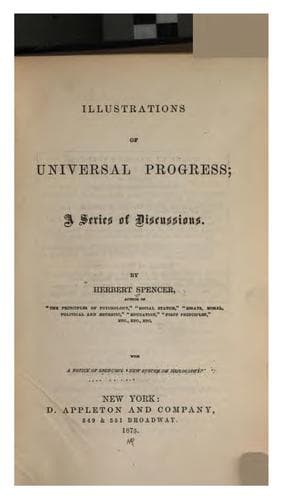
Illustrations of Universal Progress: A Series of Discussions — John Shaqi
Illustrations of Universal Progress: A Series of DiscussionsSpencer, Herbert
Philosophy
Illustrations of Universal Progress: A Series of Discussions
Spencer, Herbert
Philosophy; Political science; Science
the _tropical_ or symbolic: which were, however, used together in the same
record. In Egypt, written language underwent a further differentiation:
whence resulted the _hieratic_ and the _epistolographic_ or _enchorial_:
both of which are derived from the original hieroglyphic. At the same time
we find that for the expression of proper names which could not be
otherwise conveyed, phonetic symbols were employed; and though it is
alleged that the Egyptians never actually achieved complete alphabetic
writing, yet it can scarcely be doubted that these phonetic symbols
occasionally used in aid of their ideographic ones, were the germs out of
which alphabetic writing grew. Once having become separate from
hieroglyphics, alphabetic writing itself underwent numerous
differentiations--multiplied alphabets were produced; between most of
which, however, more or less connection can still be traced. And in each
civilized nation there has now grown up, for the representation of one set
of sounds, several sets of written signs used for distinct purposes.
Finally, through a yet more important differentiation came printing; which,
uniform in kind as it was at first, has since become multiform.
While written language was passing through its earlier stages of
development, the mural decoration which formed its root was being
differentiated into Painting and Sculpture. The gods, kings, men, and
animals represented, were originally marked by indented outlines and
coloured. In most cases these outlines were of such depth, and the object
they circumscribed so far rounded and marked out in its leading parts, as
to form a species of work intermediate between intaglio and bas-relief. In
other cases we see an advance upon this: the raised spaces between the
figures being chiselled off, and the figures themselves appropriately
tinted, a painted bas-relief was produced. The restored Assyrian
architecture at Sydenham exhibits this style of art carried to greater
perfection--the persons and things represented, though still barbarously
coloured, are carved out with more truth and in greater detail: and in the
winged lions and bulls used for the angles of gateways, we may see a
considerable advance towards a completely sculptured figure; which,
nevertheless, is still coloured, and still forms part of the building. But
while in Assyria the production of a statue proper seems to have been
little, if at all, attempted, we may trace in Egyptian art the gradual
separation of the sculptured figure from the wall. A walk through the
collection in the British Museum will clearly show this; while it will at
the same time afford an opportunity of observing the evident traces which
the independent statues bear of their derivation from bas-relief: seeing
that nearly all of them not only display that union of the limbs with the
body which is the characteristic of bas-relief, but have the back of the
statue united from head to foot with a block which stands in place of the
original wall.
Public-domain text, read in full here on John Shaqi.
Reviews
Reviews
No reviews yet
Be the first to share your thoughts on this work.
Join the Discussion
Join the discussion
Sign in to leave a comment or review.
Sign InorCreate an account