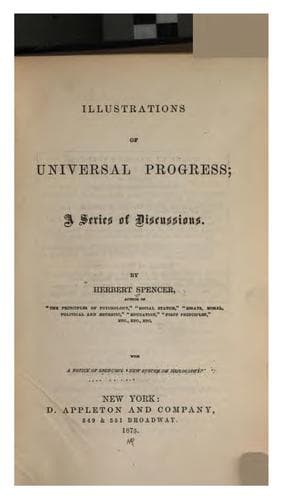
Illustrations of Universal Progress: A Series of Discussions — John Shaqi
Illustrations of Universal Progress: A Series of DiscussionsSpencer, Herbert
Philosophy
Illustrations of Universal Progress: A Series of Discussions
Spencer, Herbert
Philosophy; Political science; Science
Strange as it seems then, we find it no less true, that all forms of
written language, of painting, and of sculpture, have a common root in the
politico-religious decorations of ancient temples and palaces. Little
resemblance as they now have, the bust that stands on the console, the
landscape that hangs against the wall, and the copy of the _Times_ lying
upon the table, are remotely akin; not only in nature, but by extraction.
The brazen face of the knocker which the postman has just lifted, is
related not only to the woodcuts of the _Illustrated London News_ which he
is delivering, but to the characters of the _billet-doux_ which accompanies
it. Between the painted window, the prayer-book on which its light falls,
and the adjacent monument, there is consanguinity. The effigies on our
coins, the signs over shops, the figures that fill every ledger, the coats
of arms outside the carriage panel, and the placards inside the omnibus,
are, in common with dolls, blue-books, paper-hangings, lineally descended
from the rude sculpture-paintings in which the Egyptians represented the
triumphs and worship of their god-kings. Perhaps no example can be given
which more vividly illustrates the multiplicity and heterogeneity of the
products that in course of time may arise by successive differentiations
from a common stock.
Before passing to other classes of facts, it should be observed that the
evolution of the homogeneous into the heterogeneous is displayed not only
in the separation of Painting and Sculpture from Architecture and from each
other, and in the greater variety of subjects they embody, but it is
further shown in the structure of each work. A modern picture or statue is
of far more heterogeneous nature than an ancient one. An Egyptian
sculpture-fresco represents all its figures as on one plane--that is, at
the same distance from the eye; and so is less heterogeneous than a
painting that represents them as at various distances from the eye. It
exhibits all objects as exposed to the same degree of light; and so is less
heterogeneous than a painting which exhibits different objects and
different parts of each object as in different degrees of light. It uses
scarcely any but the primary colours, and these in their full intensity;
and so is less heterogeneous than a painting which, introducing the primary
colours but sparingly, employs an endless variety of intermediate tints,
each of heterogeneous composition, and differing from the rest not only in
quality but in intensity. Moreover, we see in these earliest works a great
uniformity of conception. The same arrangement of figures is perpetually
reproduced--the same actions, attitudes, faces, dresses. In Egypt the modes
of representation were so fixed that it was sacrilege to introduce a
novelty; and indeed it could have been only in consequence of a fixed mode
of representation that a system of hieroglyphics became possible. The
Assyrian bas-reliefs display parallel characters. Deities, kings,
Public-domain text, read in full here on John Shaqi.
Reviews
Reviews
No reviews yet
Be the first to share your thoughts on this work.
Join the Discussion
Join the discussion
Sign in to leave a comment or review.
Sign InorCreate an account