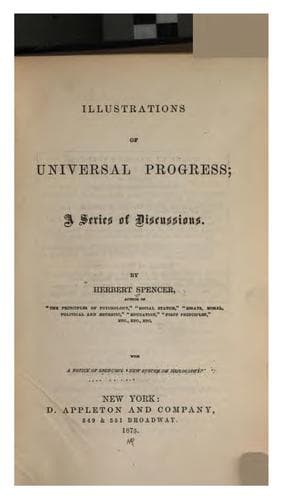
Illustrations of Universal Progress: A Series of Discussions — John Shaqi
Illustrations of Universal Progress: A Series of DiscussionsSpencer, Herbert
Philosophy
Illustrations of Universal Progress: A Series of Discussions
Spencer, Herbert
Philosophy; Political science; Science
implications might be cited from the histories of later times and peoples:
as the practices of our own early minstrels, who sang to the harp heroic
narratives versified by themselves to music of their own composition: thus
uniting the now separate offices of poet, composer, vocalist, and
instrumentalist. But, without further illustration, the common origin and
gradual differentiation of Dancing, Poetry, and Music will be sufficiently
manifest.
The advance from the homogeneous to the heterogeneous is displayed not only
in the separation of these arts from each other and from religion, but also
in the multiplied differentiations which each of them afterwards undergoes.
Not to dwell upon the numberless kinds of dancing that have, in course of
time, come into use; and not to occupy space in detailing the progress of
poetry, as seen in the development of the various forms of metre, of rhyme,
and of general organization; let us confine our attention to music as a
type of the group. As argued by Dr. Burney, and as implied by the customs
of still extant barbarous races, the first musical instruments were,
without doubt, percussive--sticks, calabashes, tom-toms--and were used
simply to mark the time of the dance; and in this constant repetition of
the same sound, we see music in its most homogeneous form.
The Egyptians had a lyre with three strings. The early lyre of the Greeks
had four, constituting their tetrachord. In course of some centuries lyres
of seven and eight strings were employed. And, by the expiration of a
thousand years, they had advanced to their "great system" of the double
octave. Through all which changes there of course arose a greater
heterogeneity of melody. Simultaneously there came into use the different
modes--Dorian, Ionian, Phrygian, AEolian, and Lydian--answering to our keys;
and of these there were ultimately fifteen. As yet, however, there was but
little heterogeneity in the time of their music.
Instrumental music during this period being merely the accompaniment of
vocal music, and vocal music being completely subordinated to words, the
singer being also the poet, chanting his own compositions and making the
lengths of his notes agree with the feet of his verses,--there unavoidably
arose a tiresome uniformity of measure, which, as Dr. Burney says, "no
resources of melody could disguise." Lacking the complex rhythm obtained by
our equal bars and unequal notes the only rhythm was that produced by the
quantity of the syllables and was of necessity comparatively monotonous.
And further, it may be observed that the chant thus resulting, being like
recitative, was much less clearly differentiated from ordinary speech than
is our modern song.
Public-domain text, read in full here on John Shaqi.
Reviews
Reviews
No reviews yet
Be the first to share your thoughts on this work.
Join the Discussion
Join the discussion
Sign in to leave a comment or review.
Sign InorCreate an account