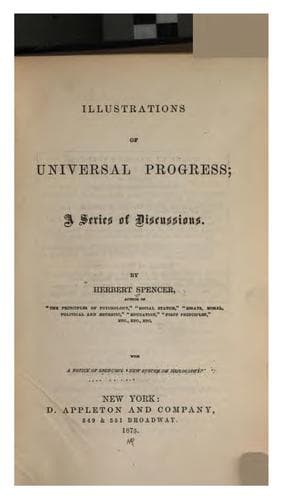
Illustrations of Universal Progress: A Series of DiscussionsSpencer, Herbert
Philosophy
Illustrations of Universal Progress: A Series of Discussions
Spencer, Herbert
Philosophy; Political science; Science
To Mr. Spencer the one conception which spans the universe and solves the
widest range of its problems--which reaches outward through boundless space
and back through illimitable time, resolving the deepest questions of life,
mind, society, history, and civilization, which predicts the glorious
possibilities of the future, and reveals the august method by which the
Divine Power works evermore,--this one, all-elucidating conception, is
expressed by the term EVOLUTION. To this great subject he has devoted his
remarkable powers of thought for many years, and stands toward it not only
in the relation of an expositor, but also in that of a discoverer.
The fact that all living beings are developed from a minute structureless
germ has long been known, while the law which governs their evolution--that
the change is ever from the homogeneous to the heterogeneous--has been
arrived at within a generation. But this fact of growth is by no means
limited to the physical history of plants and animals--it is exemplified
upon a far more extended scale. Astronomers hold that the solar system has
gone through such a process, and Geologists teach that the earth has had
its career of evolution. Animals have a mental as well as a physical
development, and there is also a progress of knowledge, of religion, of the
arts and sciences, of institutions, manners, governments, and civilization
itself. Mr. Spencer has the honour of having first established the
universality of the principle by which all these changes are governed. The
law of evolution, which has been hitherto limited to plants and animals, he
demonstrates to be the law of _all_ evolution. This doctrine is unfolded in
the first Essay of the present volume, and is more or less fully
illustrated in the others; but it will be found elaborately worked out in
the second part of _First Principles_.
The course of the discussion in this part of the work will be best shown by
enumerating the titles to the chapters, which are as follows: I. Laws in
General; II. The Law of Evolution; III. The Same continued; IV. The Causes
of Evolution; V. Space, Time, Matter, Motion, and Force; VI. The
Indestructibility of Matter; VII. The Continuity of Motion; VIII. The
Persistence of Force; IX. The Correlation and Equivalence of Forces; X. The
Direction of Motion; XI. The Rhythm of Motion; XII. The Conditions
Essential to Evolution; XIII. The Instability of the Homogeneous; XIV. The
Multiplication of Effects; XV. Differentiation and Integration; XVI.
Equilibration; XVII. Summary and Conclusion.
A most interesting and fruitful field of thought, it will be seen, is here
traversed by our author, and the latest and highest questions of science
are discussed under novel aspects and in new relations. Not only do the
pages abound with acute suggestions and fresh views, but the entire
argument, in its leading demonstrations, and the full breadth of its
philosophic scope, is stamped with a high originality.
Public-domain text, read in full here on John Shaqi.
Reviews
Reviews
No reviews yet
Be the first to share your thoughts on this work.
Join the Discussion
Join the discussion
Sign in to leave a comment or review.
Sign InorCreate an account