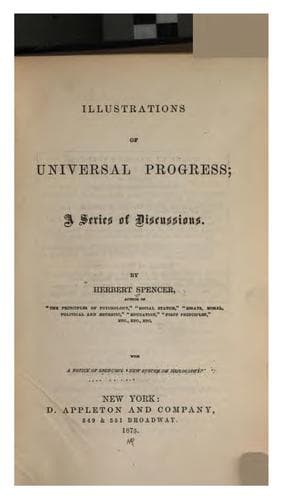
Illustrations of Universal Progress: A Series of DiscussionsSpencer, Herbert
Philosophy
Illustrations of Universal Progress: A Series of Discussions
Spencer, Herbert
Philosophy; Political science; Science
Suppose that by a series of upheavals, occurring, as they are now known to
do, at long intervals, the East Indian Archipelago were to be, step by
step, raised into a continent, and a chain of mountains formed along the
axis of elevation. By the first of these upheavals, the plants and animals
inhabiting Borneo, Sumatra, New Guinea, and the rest, would be subjected to
slightly modified sets of conditions. The climate in general would be
altered in temperature, in humidity, and in its periodical variations;
while the local differences would be multiplied. These modifications would
affect, perhaps inappreciably, the entire flora and fauna of the region.
The change of level would produce additional modifications: varying in
different species, and also in different members of the same species,
according to their distance from the axis of elevation. Plants, growing
only on the sea-shore in special localities, might become extinct. Others,
living only in swamps of a certain humidity, would, if they survived at
all, probably undergo visible changes of appearance. While still greater
alterations would occur in the plants gradually spreading over the lands
newly raised above the sea. The animals and insects living on these
modified plants, would themselves be in some degree modified by change of
food, as well as by change of climate; and the modification would be more
marked where, from the dwindling or disappearance of one kind of plant, an
allied kind was eaten. In the lapse of the many generations arising before
the next upheaval, the sensible or insensible alterations thus produced in
each species would become organized--there would be a more or less complete
adaptation to the new conditions. The next upheaval would superinduce
further organic changes, implying wider divergences from the primary forms;
and so repeatedly.
Public-domain text, read in full here on John Shaqi.
Reviews
Reviews
No reviews yet
Be the first to share your thoughts on this work.
Join the Discussion
Join the discussion
Sign in to leave a comment or review.
Sign InorCreate an account