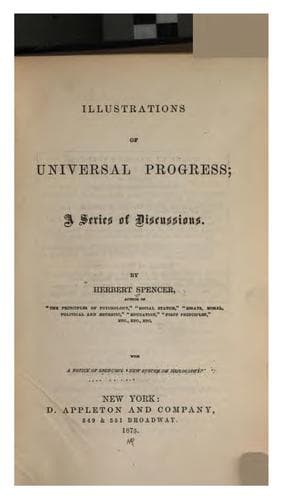
Illustrations of Universal Progress: A Series of DiscussionsSpencer, Herbert
Philosophy
Illustrations of Universal Progress: A Series of Discussions
Spencer, Herbert
Philosophy; Political science; Science
But now let it be observed that the revolution thus resulting would not be
a substitution of a thousand more or less modified species for the thousand
original species; but in place of the thousand original species there would
arise several thousand species, or varieties, or changed forms. Each
species being distributed over an area of some extent, and tending
continually to colonize the new area exposed, its different members would
be subject to different sets of changes. Plants and animals spreading
towards the equator would not be affected in the same way with others
spreading from it. Those spreading towards the new shores would undergo
changes unlike the changes undergone by those spreading into the mountains.
Thus, each original race of organisms, would become the root from which
diverged several races differing more or less from it and from each other;
and while some of these might subsequently disappear, probably more than
one would survive in the next geologic period: the very dispersion itself
increasing the chances of survival. Not only would there be certain
modifications thus caused by change of physical conditions and food, but
also in some cases other modifications caused by change of habit. The fauna
of each island, peopling, step by step, the newly-raised tracts, would
eventually come in contact with the faunas of other islands; and some
members of these other faunas would be unlike any creatures before seen.
Herbivores meeting with new beasts of prey, would, in some cases, be led
into modes of defence or escape differing from those previously used; and
simultaneously the beasts of prey would modify their modes of pursuit and
attack. We know that when circumstances demand it, such changes of habit
_do_ take place in animals; and we know that if the new habits become the
dominant ones, they must eventually in some degree alter the organization.
Observe, now, however, a further consequence. There must arise not simply a
tendency towards the differentiation of each race of organisms into several
races; but also a tendency to the occasional production of a somewhat
higher organism. Taken in the mass these divergent varieties which have
been caused by fresh physical conditions and habits of life, will exhibit
changes quite indefinite in kind and degree; and changes that do not
necessarily constitute an advance. Probably in most cases the modified type
will be neither more nor less heterogeneous than the original one. In some
cases the habits of life adopted being simpler than before, a less
heterogeneous structure will result: there will be a retrogradation. But it
_must_ now and then occur, that some division of a species, falling into
circumstances which give it rather more complex experiences, and demand
actions somewhat more involved, will have certain of its organs further
differentiated in proportionately small degrees,--will become slightly more
heterogeneous.
Public-domain text, read in full here on John Shaqi.
Reviews
Reviews
No reviews yet
Be the first to share your thoughts on this work.
Join the Discussion
Join the discussion
Sign in to leave a comment or review.
Sign InorCreate an account