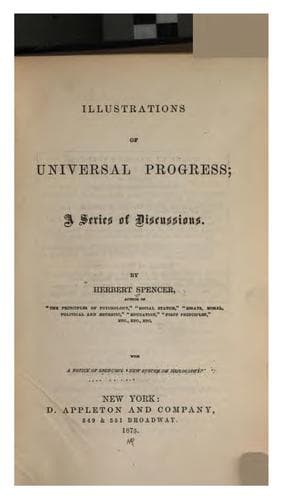
Illustrations of Universal Progress: A Series of DiscussionsSpencer, Herbert
Philosophy
Illustrations of Universal Progress: A Series of Discussions
Spencer, Herbert
Philosophy; Political science; Science
Thus, in the natural course of things, there will from time to time arise
an increased heterogeneity both of the Earth's flora and fauna, and of
individual races included in them. Omitting detailed explanations, and
allowing for the qualifications which cannot here be specified, we think it
is clear that geological mutations have all along tended to complicate the
forms of life, whether regarded separately or collectively. The same causes
which have led to the evolution of the Earth's crust from the simple into
the complex, have simultaneously led to a parallel evolution of the Life
upon its surface. In this case, as in previous ones, we see that the
transformation of the homogeneous into the heterogeneous is consequent upon
the universal principle, that every active force produces more than one
change.
The deduction here drawn from the established truths of geology and the
general laws of life, gains immensely in weight on finding it to be in
harmony with an induction drawn from direct experience. Just that
divergence of many races from one race, which we inferred must have been
continually occurring during geologic time, we know to have occurred during
the pre-historic and historic periods, in man and domestic animals. And
just that multiplication of effects which we concluded must have produced
the first, we see has produced the last. Single causes, as famine, pressure
of population, war, have periodically led to further dispersions of mankind
and of dependent creatures: each such dispersion initiating new
modifications, new varieties of type. Whether all the human races be or be
not derived from one stock, philology makes it clear that whole groups of
races now easily distinguishable from each other, were originally one
race,--that the diffusion of one race into different climates and
conditions of existence, has produced many modified forms of it.
Public-domain text, read in full here on John Shaqi.
Reviews
Reviews
No reviews yet
Be the first to share your thoughts on this work.
Elsewhere in the archive
Join the Discussion
Join the discussion
Sign in to leave a comment or review.
Sign InorCreate an account